The Digital Nomad Visa (DNV) is a visa for remote workers, launched in January 2023 under the Startup Act (Ley de Startups). Following the cancellation of the Golden Visa in April 2025, it has become the most popular route to legal residency in Spain for those working remotely.
The visa allows you to live and work in Spain while keeping a contract with a foreign employer or serving overseas clients. Path to permanent residency after 5 years, citizenship after 10. The Beckham Law tax regime reduces your rate to 24% for the first 6 years.
What Is the Digital Nomad Visa
Official name: "Autorización de residencia para teletrabajo de carácter internacional" (residence authorization for international remote work). The visa is intended for non-EU/EEA citizens who work remotely using digital technologies for companies or clients located outside Spain.
Key features: up to 20% of income may come from Spanish clients, the remaining 80% must be from abroad. You can be an employee of a foreign company, a freelancer, or self-employed. The visa covers family members: spouse, children, and dependent relatives. Since launch, approximately 28,000 visas have been issued through end of 2025.
Who Can Apply
Applicant Requirements
| Parameter | Requirement |
|---|---|
| Age | 18+ |
| Citizenship | Non-EU/EEA |
| Prior residency in Spain | Must not have been a resident in the last 5 years |
| Criminal record | Clean — in Spain and countries of residence for the last 2 years |
| Illegal stay | Must not have been in Spain illegally in the last 5 years |
Work Requirements
| Parameter | Requirement |
|---|---|
| Type of work | Remote, using digital technologies |
| Employer / clients | Located outside Spain (≥80% of income) |
| Tenure at company | Minimum 3 months |
| Company operating period | Minimum 1 year |
| Contract duration | Must cover at least 1 year of remote work |
| Spanish clients | No more than 20% of total income |
Education Requirements
Bachelor's or master's degree from a recognised university OR minimum 3 years of professional experience in your current field.
Minimum Income
Income is tied to Spain's Minimum Interprofessional Salary (SMI). In 2026, the SMI is ~€1,425/month (14 payments per year).
| Family composition | Minimum income |
|---|---|
| Single applicant (200% SMI) | ~€2,850/month (~€34,200/year) |
| + spouse/partner (75% SMI) | + ~€1,070/month |
| + each child (25% SMI) | + ~€360/month |
| Family of 3 | ~€4,280/month |
| Family of 4 | ~€4,640/month |
Income is verified through contracts, employer letters, invoices (for freelancers), and bank statements for 3–6 months. Important: bank statements must match declared income — immigration authorities check actual fund flows.
Tip: When declaring income, it is advisable to show 5–10% above the minimum threshold to account for currency fluctuations and improve approval chances.
Health Insurance
Full coverage from an insurer authorised to operate in Spain is mandatory. No copayments (copago), no coverage limits. The policy must cover all risks covered by Spain's public healthcare system: hospitalisation, outpatient care, emergency treatment, preventive care, rehabilitation, and urgent transport. Travel insurance is not accepted.
If you register with the Spanish Social Security system, separate health insurance may not be required.
Documents Required
Main applicant:
- National visa application form (formulario de solicitud)
- Passport (valid, minimum 1 year remaining)
- Photo 3.5×4.5 cm (white background)
- Criminal record certificate — apostilled and translated
- Health insurance
- Proof of qualification: degree OR confirmation of 3+ years experience
- Employment contract with remote work authorisation OR client contracts (for freelancers)
- Company registration certificate (Companies House or equivalent) — confirming at least 1 year of operation
- Proof of income: statements for 3–6 months, payslips, invoices
- Social security coverage proof from home country (A1 for UK) OR registration with Spanish Seguridad Social
- Paid government fee: tasa 790-038 (~€73)
For family members (additionally):
- Marriage / birth certificates — apostilled and translated
- Proof of financial dependence (for adult children)
- Criminal record certificate (for adults)
All documents not in Spanish require sworn translation (traducción jurada). Documents from Hague Convention countries require an apostille.
Where and How to Apply
Option 1. From abroad — at a Spanish consulate
The standard route for those outside Spain.
- Book an appointment at the Spanish consulate in your country.
- Prepare and translate documents.
- Submit the application in person.
- Wait for a decision: 15–45 business days.
- If approved, the visa is placed in your passport. Validity: up to 1 year.
- Upon arrival in Spain, you can apply for residency (up to 3 years) or live on the visa.
Pros: Start the process from home, no need to travel beforehand. Cons: Appointments at some consulates are booked 1–3 months ahead. Visa is only for 1 year (not 3).
Option 2. From within Spain — through UGE
Available if you are in Spain legally (visa-free entry, tourist visa, etc.).
- Enter Spain under visa-free arrangements (up to 90 days).
- Obtain your NIE.
- Submit the application for residence authorisation through UGE-CE (Unidad de Grandes Empresas y Colectivos Estratégicos) — the unit that processes startup and digital nomad visas.
- Processing time: 20 business days (official timeframe).
- If approved — residence permit for up to 3 years.
Pros: Immediate 3-year residency. Faster than the consulate route. Cons: Must be in Spain legally at the time of application. Need a NIE in advance.
Tip: Many applicants apply from within Spain, combining it with a property viewing trip. Come for 2–3 weeks, get your NIE, apply for the DNV, and view properties at the same time.
Validity and Renewal
| Stage | Duration |
|---|---|
| Visa (from consulate) | up to 1 year |
| Residence permit (from Spain) | up to 3 years |
| First renewal | + 2 years |
| Permanent residency | after 5 years |
| Citizenship | after 10 years (2 years for Ibero-American citizens) |
For renewal: maintain remote work, live in Spain for at least 183 days per year, continue to meet income requirements.
Tax Regime: The Beckham Law
This is the main tax advantage of the Digital Nomad Visa. Official name: "Special Regime for Displaced Workers" (Article 93 of Law 35/2006 on IRPF).
How it works: You become a Spanish tax resident (living >183 days) but are taxed under non-resident rules (IRNR) instead of the progressive IRPF scale.
Rates under the Beckham Law:
| Income | Rate |
|---|---|
| Up to €600,000/year | 24% (flat) |
| Above €600,000 | 47% |
Comparison with standard IRPF rates:
| Income | Standard IRPF | With Beckham Law |
|---|---|---|
| €30,000 | ~24% | 24% |
| €60,000 | ~30–37% | 24% |
| €100,000 | ~37–42% | 24% |
| €200,000 | ~43–47% | 24% |
At an income of €100,000, the saving is €13,000–€18,000 per year, or €78,000–€108,000 over 6 years.
- Foreign income (dividends, rental, capital gains abroad) — not taxed in Spain.
- Wealth tax (Impuesto sobre el Patrimonio) — applies only to assets in Spain, not worldwide.
- Double taxation — Spain has treaties with 90+ countries.
- Not a Spanish tax resident in the previous 5 years.
- Relocation is work-related (DNV automatically qualifies).
- Apply (Form 149) within 6 months of registering with Seguridad Social. Missing this deadline = losing the right to the regime.
- Applies for the year of arrival plus 5 subsequent years (6 years total).
- Standard freelancers (autónomos) without a Digital Nomad Visa.
- Professional athletes.
- Owners of >25% of an asset-holding company (not a startup).
Important: The Beckham Law does not apply automatically. You must apply to the Tax Agency (Agencia Tributaria) within 6 months. Working with a tax advisor is strongly recommended.
Social Security
If your country has a social security agreement with Spain, you can remain in your home country's system (you need an A1 certificate or equivalent). Agreements are in place with the US, Canada, Australia, China, and most EU countries.
If there is no agreement, or you prefer the Spanish system, you register with Seguridad Social. For employees: the employer pays ~€500–€600/month. For self-employed (autónomo): from ~€230/month (income-based progressive scale).
Registration with Seguridad Social gives access to public healthcare (no separate insurance needed), pension contributions, and benefits.
Digital Nomad Visa vs Non-Lucrative Visa
| Parameter | Digital Nomad Visa | Non-Lucrative Visa |
|---|---|---|
| Can you work | Yes (remotely) | No |
| Minimum income | ~€2,850/month | ~€2,400/month |
| Income source | Salary / contracts | Passive (pension, dividends) |
| Beckham Law (24%) | Yes | No |
| Apply from Spain | Yes | No (consulate only) |
| Initial duration | Up to 3 years | 1 year |
| Path to permanent residency | 5 years | 5 years |
| Family | Yes | Yes |
Choose DNV if you work remotely and want tax benefits. Choose Non-Lucrative if you live on passive income and don't plan to work.
Can You Buy Property with a Digital Nomad Visa
Yes. The DNV gives you resident status, which simplifies many processes:
- Opening a bank account (as a resident, not a non-resident)
- Mortgage on better terms (LTV up to 80% instead of 60–70%)
- Connecting utilities
- Tax declarations
Buying property does not affect your DNV status and is not a requirement for it. But if you plan to live in Spain, owning property may be more cost-effective than renting, especially with mortgage rates from 2.5% for residents.
Tip: For more on the buying process, see our guide "How to Buy Property in Spain."
Best Cities for Digital Nomads on the Costa Blanca
Alicante
Provincial capital and one of Spain's best cities for remote work. International airport with direct flights across Europe. Urban infrastructure: coworking spaces, cafés with Wi-Fi, public transport. Cost of living 30–40% lower than Barcelona and Madrid. 300+ sunny days per year. San Juan beach — 7 km of sand, 15 minutes from the centre. Growing expat and digital nomad community.
Jávea
Resort town on the northern Costa Blanca with an international atmosphere. Large British and Scandinavian community. Relaxed pace of life, nature reserves, three types of coastline (sand, pebble, rocky). Good internet, several coworking spaces. 1 hour to Alicante airport, 1.5 hours to Valencia. Ideal for families — international schools, safety, sea.
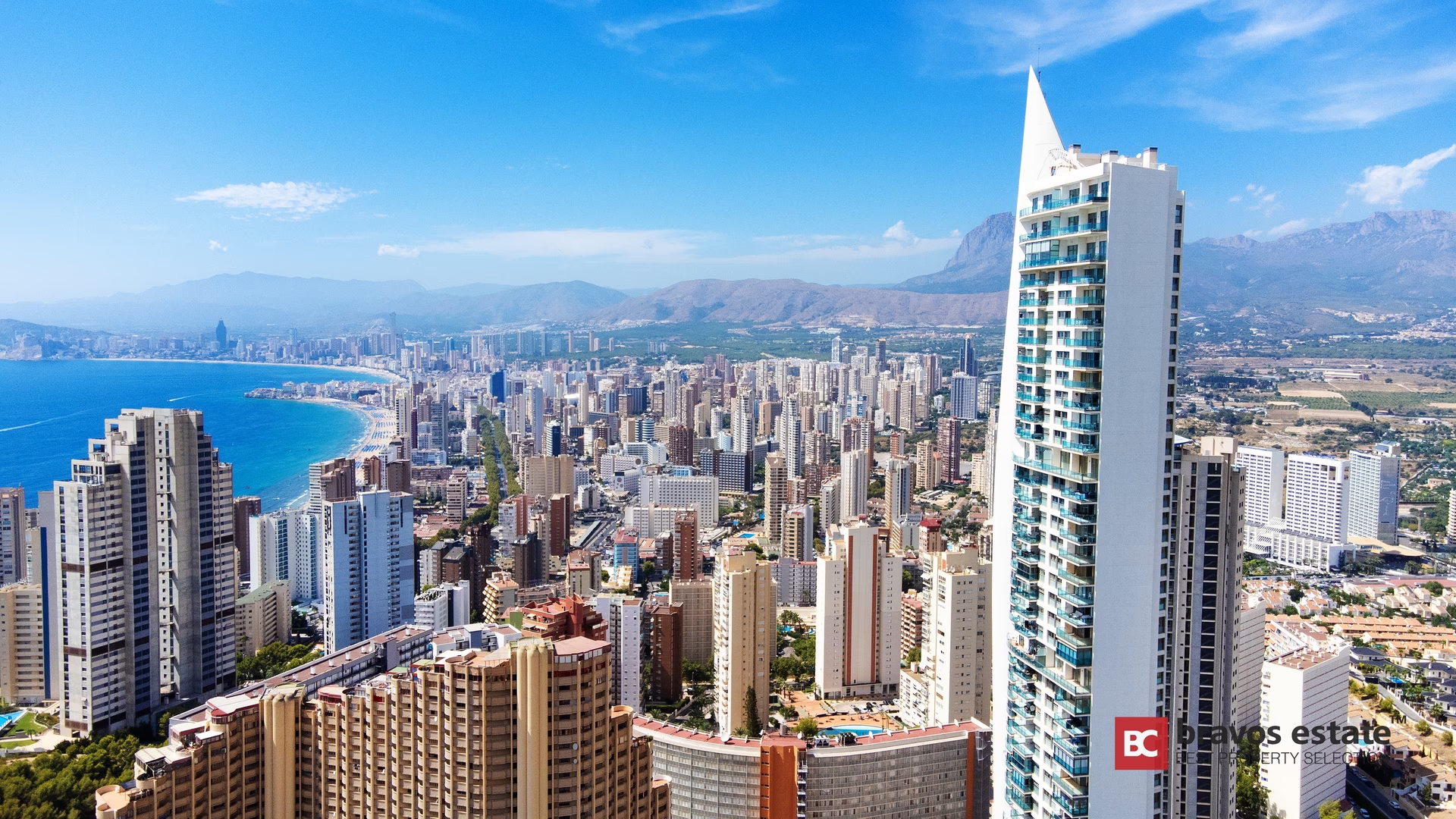
Benidorm
Full urban infrastructure in a resort setting. High-speed internet, well-developed public transport (tram to Alicante). Wide range of housing at various price points. Year-round activity — not a "dead" town in winter. Alicante airport — 40 minutes.
Cost of the Digital Nomad Visa
| Item | Cost |
|---|---|
| Government fee (tasa 790-038) | ~€73 per person |
| Sworn translation of documents | €200–€500 |
| Apostille | €10–€50 per document |
| Health insurance (annual) | €600–€1,500 |
| Legal assistance (optional) | €500–€2,000 |
| NIE (if obtained separately) | €12 |
Estimated total: €1,500–€4,000 per person for the initial application, depending on whether you use a lawyer and how many documents need translation. Health insurance is an annual recurring cost. If applying from abroad, factor in travel and accommodation expenses for the consulate appointment or a trip to Spain to apply in person through UGE.
Planning the whole move, not just the visa? Our guide to moving to Spain puts residency, healthcare, taxes and housing into one sequence.