Selling a Spanish property as a non-resident is mechanically the same transaction it has always been — but the rules around tax withholding, energy certificates, mortgage cancellation, and currency repatriation have shifted enough over the last five years that the guidance you got when you bought is now incomplete. This is the 2026 picture, written for owners who do not live in Spain full-time.
Three things have changed materially since most foreign owners bought their property:
- The 3% withholding tax at sale (retención) and the capital gains tax (CGT) rates for non-residents — once a 19% / 24% split — are now consistently applied and tightly tracked by the Spanish tax agency (AEAT). The grey-zone of "the buyer's lawyer will sort it" is over.
- The Energy Performance Certificate (Certificado de Eficiencia Energética, or CEE) has been mandatory since 2013 but enforcement is now strict — without it, a sale cannot legally close at notary.
- The plusvalía municipal tax was rewritten in 2021 after the constitutional court struck down the previous formula. The new rules let owners actually choose the calculation method that produces the lower bill.
If you bought your property before 2018 and have not been involved in any of the bureaucracy since, plan on a sale process of three to six months from listing to keys-and-money — and budget for tax and selling costs of around 7–11% of the sale price, before any agent commission. The detail of why is below.
Is 2026 a good time to sell?
The short version: prices on the Costa Blanca and across the Mediterranean coast are at multi-year highs and demand from foreign buyers remains strong. The Bank of Spain's Spring 2026 Financial Stability Report (published 14 May 2026) judges the market mildly overvalued versus long-term equilibrium but not in 2008-style bubble territory — full discussion of that in our analysis of the Bank of Spain report. For sellers, what matters is that the buyer side has not pulled back, supply is constrained, and a well-priced, well-prepared property is selling in 90 to 150 days in the main coastal markets.
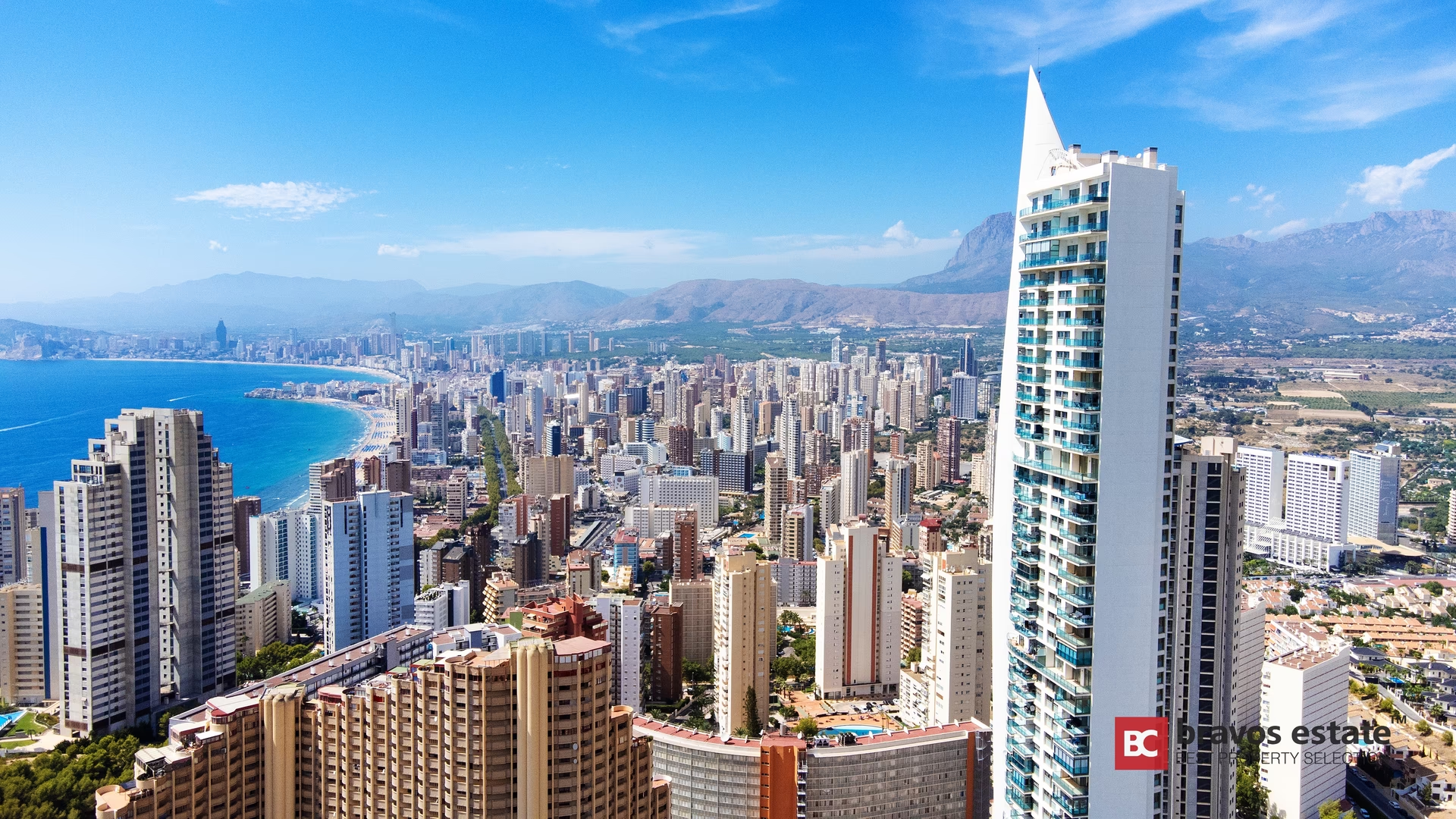
Tinsa's Q1 2026 data showed Alicante province prices up 18.3% year-on-year, with Benidorm hitting €2,786/m² and Alicante City €1,980/m². Sales volumes cooled 7.7% in the same quarter — the classic profile of a supply-constrained market where prices rise while transaction count softens. For an owner sitting on a property bought 7–12 years ago, the gap between today's price and your acquisition cost is likely the largest it has ever been.
The honest counterweight: if you sell now and need to redeploy capital into another asset (including buying a smaller Spanish property), inflation has eroded the relative purchasing power of your sale euros versus 2008. Real net gain is meaningful but not as dramatic as the nominal numbers suggest.
The four taxes you will pay
This is the single most misunderstood part of the process. Foreign owners regularly believe they will receive 100% of the sale price minus an agent commission. The actual net is materially lower. There are four taxes that touch the sale:
1. The 3% withholding (retención del 3%)
If you are a non-resident for Spanish tax purposes, the buyer is legally required to withhold 3% of the gross sale price and pay it directly to the Spanish tax agency (AEAT) within one month of completion, using Modelo 211. You receive 97% on the day; the missing 3% sits at AEAT as an advance against your eventual capital gains tax bill.
This is not optional and it is not negotiable. The buyer who fails to withhold becomes personally liable for that 3% — so any decent buyer's lawyer will insist on the deduction at notary.
If your final CGT bill is less than the 3% withheld, you can reclaim the difference by filing Modelo 210 within four months. If the bill is more, you pay the difference at the same time.
2. Capital gains tax (IRNR)
Non-resident sellers pay capital gains tax on the profit from the sale. The rate is 19% for EU/EEA residents and 24% for non-EU residents (which includes UK and US owners post-Brexit).
"Profit" is calculated as: sale price minus the original acquisition price, minus eligible costs of acquisition (notary, registration, ITP transfer tax you paid when buying, lawyer fees if invoiced) and eligible improvements (structural works with proper invoices and VAT receipts — not redecoration). Cosmetic refurbishment is not deductible. Keep every invoice from the day you bought; the AEAT will only accept properly issued Spanish invoices in the deduction.
The bill is filed on Modelo 210 within four months of completion. The 3% already withheld counts as a credit. There is no reinvestment exemption available to non-residents — only Spanish tax residents over 65 (selling a primary residence) or those reinvesting into a Spanish primary residence benefit. The exemption does not apply to foreign owners selling holiday or rental property.
Your home country may have a double tax treaty with Spain that allows you to credit the Spanish CGT against your domestic liability. Spain has treaties with all major countries; the credit typically applies in full. This is where personalised tax advice in your country of residence is worth far more than it costs.
3. Plusvalía municipal (Impuesto sobre el Incremento del Valor de los Terrenos)
This is a municipal tax on the increase in the cadastral land value (not the property's market value) over the years you owned it. It is paid to the local town hall, and the seller pays it.
Since 2021, after the constitutional court struck down the previous formula, owners can choose between two calculation methods and pay whichever is lower:
- The objective method — based on cadastral land value multiplied by years of ownership × a municipal coefficient. This is the historical formula.
- The real method — based on the actual difference between the cadastral land value at acquisition and at sale. If the actual land value rose less than the objective method assumes, this can be substantially cheaper.
The bill is typically 0.5–3% of the property value, but varies enormously by municipality. In some Costa Blanca towns the cadastral values are deliberately set low and the plusvalía bill is modest; in Madrid or Barcelona it can be material. A local lawyer (gestor) will calculate both methods and submit the lower one.
Critically: if your sale produces no land-value increase (or even a loss), no plusvalía is owed — but you must still submit the filing to claim the exemption. Do not let your buyer's lawyer pay automatically without checking.
4. VAT/IVA — rarely applicable to private sellers
Resale property between private individuals is not subject to IVA (Spanish VAT). The buyer pays a transfer tax (ITP) instead, which is their cost, not yours. IVA only applies if you are selling as a business or selling a brand-new property as the original developer — neither of which applies to typical foreign owners reselling holiday homes.
For the bigger annual-tax picture (IBI, non-resident income tax on imputed rent, wealth tax for high-value owners), see our full guide to Spanish property tax for non-residents.
Estimate your actual numbers: our Spain selling costs calculator projects your net proceeds based on sale price, region, ownership profile, and current rates — including all four taxes above, agent commission, and gestor/notary fees. If you are weighing a replacement purchase, the Spain buying costs calculator shows the next acquisition cost on top, and the Spain mortgage calculator sizes any financing you might need.
| Tax | Rate | When and how |
|---|---|---|
| 3% withholding (retención) | 3% of the gross price — non-residents | Withheld by the buyer at the notary; Modelo 211 within 1 month |
| Capital gains tax (IRNR) | 19% EU/EEA · 24% non-EU, on the profit | Modelo 210 within 4 months; the 3% withheld is credited |
| Plusvalía municipal | Varies by town hall — the lower of two methods | Paid by the seller to the town hall |
| VAT (IVA) | Not applicable between private individuals | — |
The documents your buyer's lawyer will demand
The Spanish notary will not sign the escritura de compraventa (the sale deed) without a defined set of documents. Buyers' lawyers begin pulling these together two to four weeks before the planned signing date. If any are missing or out of date, the closing slips.
Pull these together before you list:
- Nota Simple — current land registry extract showing you as the legal owner, with any mortgages and charges visible. Order from the Registro de la Propiedad; takes 24–72 hours.
- Original Escritura de Compraventa — the deed from when you bought. If you have lost it, the notary who handled the original sale can issue a copy.
- Certificado de Eficiencia Energética (CEE) — the energy performance certificate. Valid 10 years. If yours is older, you must renew before listing. Cost €100–300 from a certified architect or technical engineer. This is non-optional since 2013 and the rule is now enforced.
- Cédula de Habitabilidad — habitation certificate. Required in Valencian Community (which covers Costa Blanca), Catalonia, and Balearics. Renewed every 10–15 years depending on region. Cost €60–150.
- IBI receipts — proof the annual local property tax is paid up to date (last 4 years).
- Community fee clearance certificate — issued by your community president/administrator confirming all fees are paid up. Without this, your community can lodge a charge against the property post-sale.
- Recent utility bills — electricity, water, gas — showing supply is active and bills paid.
- NIE — your Spanish tax ID. Still valid? If lost, you need to reissue before signing. See our NIE guide for the process.
An organised seller arrives at the notary with everything in a labelled folder. A disorganised seller adds 2–6 weeks of delay and risks the buyer walking away.
Should you sell with an agency or directly?
Direct sale on Idealista or Fotocasa is technically possible and works for some sellers — especially Spanish-speakers selling a simple, fairly-priced property in a liquid local market, with patience and comfort handling viewings, documentation, and the legal coordination yourself.
For non-resident owners, an agency-managed sale usually makes economic sense for four reasons:
1. Buyer reach is structurally larger
An owner-listed property reaches Spanish-speaking buyers casually browsing Idealista. A well-positioned agency reaches a curated email list, international portals in seven languages, partner networks across Europe, and recurring relationships with buyers in active search. The total addressable buyer pool is typically three to five times larger — which matters when matching the right buyer to a niche property (sea view, large terrace, specific community).
2. The documentation and tax steps actually get done correctly
Energy certificate renewed in time. Cédula confirmed valid for the right region. Community fee certificate requested two weeks before signing. Modelo 211 and 210 explained, with reliable gestor partners introduced. A mid-transaction surprise here costs more than the entire agency commission would.
3. Pricing is set with current comparables, not optimism
Owners overprice their own property in a documented majority of cases — sometimes by 15–25%. The penalty is that the overpriced listing sits for 9–14 months while market interest moves on, then sells at the original right-price or below. An agency with weekly transaction data on your specific area sets the price you will actually achieve, with less time on market and a stronger final negotiation position.
4. Negotiation is professional, not personal
When a buyer's offer comes in 8% below asking, an owner who has lived in the property for a decade hears it as personal criticism. An agency hears it as a normal opening move. Net price tends to be meaningfully higher when there is a calm third party in the room.
Spanish agency commission — what it actually costs
The Spanish market norm is 3%–6% + IVA of the sale price, paid by the seller, with the lower end for higher-value sales and the higher end for sub-€300K listings. There is no national regulator on commission rates; everything is negotiated.
On a €400,000 sale at 5%, that is €20,000 + €4,200 IVA = €24,200. The arithmetic case for the commission is straightforward: agency-managed sales typically achieve a higher final price than DIY, sell faster (reducing the months of carrying costs — community fees, IBI, utilities, opportunity cost), and dramatically lower the risk of a tax or documentation error costing several thousand euros. For a non-resident with no Spanish-language and limited time to manage viewings remotely, the maths usually favours the commission.
What you should expect to be included in the commission:
- Professional photography, floor plan, drone or aerial imagery, virtual tour
- Listing on the major Spanish portals (Idealista, Fotocasa, Habitaclia) plus the agency's own multilingual site
- Translation of listing copy into the languages of the agency's main buyer markets
- Buyer screening (proof of funds, qualified interest)
- Visit coordination, accompanied viewings
- Negotiation
- Documentation tracking (CEE, Cédula, community certificate, IBI clearance)
- Coordination with lawyer/gestor (often a partner you can use)
- Notary scheduling and pre-signing review
- Currency transfer/repatriation guidance
If the commission proposal does not include all of the above, you are not getting full service.
When direct sale (DIY) might actually work
To be honest about it: direct listing on Idealista is a reasonable choice if every one of the following is true:
- You speak Spanish comfortably and can handle a notary appointment without an interpreter
- Your property is in a high-demand, liquid micro-market where buyers compete (central Madrid flat, frontline Costa del Sol beach apartment)
- You have flexibility on timeline and can absorb 6–12 months on market
- You are comfortable with the documentation steps and have a trusted Spanish lawyer/gestor on retainer
- The property is straightforward (no mortgage cancellation, no joint ownership disputes, no inherited title)
If even one of these is false, an agency typically pays for itself.
The sale process — step by step
From a buyer's accepted offer to the keys-and-money handover, the typical Spanish sale runs four to ten weeks. The phases:
1. Offer and acceptance — informal agreement on price and broad terms. Not binding.
2. Reservation (Reserva) — buyer pays €1,000–€6,000 to hold the property off-market for 1–2 weeks while their lawyer does due diligence. If the buyer walks, they typically forfeit the reserva; if you walk, you return it. A simple private document, not yet a notarised contract.
3. Arras contract (Contrato de Arras) — buyer pays 10% of the purchase price as a binding deposit. If the buyer walks now, they lose the 10%; if you walk, you return the 10% plus an equal amount as penalty (so you pay 20% total). This is the point at which the sale becomes legally enforceable.
4. Mortgage cancellation, if applicable — if you have an outstanding mortgage, your bank prepares a cancellation certificate to be presented at notary. The buyer's lawyer requests this and the mortgage is repaid from the sale proceeds at completion. There is typically a small cancellation fee (0.5–1% of the outstanding balance). See our Spanish mortgage guide for context on how foreign-owner mortgages are structured.
5. Notary signing (Escritura Pública de Compraventa) — at the notary's office, both parties (or their power-of-attorney holders) sign the deed of sale. The buyer pays the balance via banker's draft. The 3% retención is withheld here. The notary registers the change of ownership with the Land Registry within hours.
6. Keys and post-signing — keys handed over at signing or by agreed date. Utility transfer, community notification, and final mail forwarding take 2–6 weeks.
If you cannot be physically present at notary, a power of attorney (poder) granted to a trusted Spanish lawyer is standard and routine. Cost €100–300 plus the lawyer's representation fee.
| Stage | Money involved | Binding? | Typical timing |
|---|---|---|---|
| Offer and acceptance | — | Not binding | Day 0 |
| Reservation (reserva) | €1,000-6,000 | Buyer forfeits it if they walk away | 1-2 weeks of due diligence |
| Arras contract | 10% deposit | Buyer loses the 10%; seller returns it doubled | Signed after due diligence |
| Completion at the notary | Balance of the price | Final transfer of keys and title | 4-10 weeks from offer overall |
The six most expensive mistakes non-resident sellers make
- Treating the 3% retención as "lost" money. It is an advance on your CGT and most or all of it comes back when you file Modelo 210 — if you actually file. Many non-resident sellers never file and forfeit the refund.
- Not keeping original invoices from the purchase and any structural works. These reduce your CGT base. Without them, you pay 19% / 24% on a larger profit figure than you should.
- Pricing the property at "what I think it is worth" rather than what comparable sales actually closed at. Time on market kills more sales than any other factor.
- Letting the energy certificate, cédula, or community-fee certificate expire and only noticing the week before notary. Result: 2–6 weeks of delay, and a frustrated buyer who may walk.
- Paying plusvalía under the objective method when the real method would be cheaper or zero. A competent gestor calculates both. An automatic payment by the buyer's lawyer takes the easier path.
- Forgetting to declare in your country of tax residence. Even after Spanish CGT is paid, your home country may require a declaration. Tax treaties usually prevent double payment, but only if you file in time.
Special situations
Joint ownership and divorces
Property held in two names requires both signatures (or both powers of attorney) at notary. In divorce cases, the sale often proceeds under a court-ordered or mutually agreed division — a Spanish lawyer with family-law experience is essential here, not the same person handling the conveyance.
Inherited property
If you sell a property you inherited, your CGT base is the value declared on the inheritance tax filing (Modelo 650), not what the previous owner originally paid. This usually produces a lower CGT bill. Keep the inheritance documentation with the rest of the file.
Selling with an outstanding mortgage
The mortgage is repaid from the sale proceeds at completion — your bank coordinates this with the buyer's lawyer. The cancellation fee (0.5–1% of the outstanding balance) plus a small notarial cost are typical. You walk away with the net.
Property bought under the (now-extinct) Golden Visa
The Golden Visa programme ended in April 2025. If you bought under the scheme, the sale follows normal rules — there is no special exit obligation. If your residency permit is currently linked to the property, talk to an immigration lawyer before signing; your residency may need an alternative basis (Non-Lucrative, Digital Nomad, etc.) post-sale.
After the sale: filings and money movement
Three things to do within the first six months after closing:
File Modelo 210 within four months of completion to declare the capital gain and reclaim (or top up) against the 3% retención. Standard fee from a gestor is €150–€400.
Repatriate the sale proceeds to your home country using a specialist currency transfer service rather than your Spanish high-street bank. On a €400K transfer the cost difference between (for example) Wise or a dedicated FX broker and a traditional bank is typically €4,000–€10,000 in your favour. The transfer itself is straightforward, but document the source of funds for receiving-country compliance.
Decide what to do with your NIE. The Spanish tax ID remains valid indefinitely. If you may buy in Spain again, or have any ongoing Spanish income (rental, dividends, pension), keep it active. There is no annual fee or obligation.
If you intend to buy a replacement property in Spain — a smaller flat, a different region, a coastal upgrade — the process is the mirror image of selling, with its own preparation. Our step-by-step guide to buying property in Spain covers the full buyer-side process; the costs of buying guide breaks down what the next purchase will actually cost (about 10–13% on top of the headline price).
How Bravos Estate can help on the seller side
Most Spanish agencies focus almost entirely on buyer-side representation — listing property is the easy revenue, marketing it actively is the hard work. Bravos Estate works both sides. For non-resident sellers we handle:
- Property valuation against current Tinsa and registered-sale comparables for the specific area
- Multilingual marketing (listing and direct outreach in seven languages — the same audiences we serve as buyers)
- Professional photography, drone, and 3D virtual tour
- Documentation preparation (CEE, Cédula coordination, community certificate, IBI clearance)
- Buyer screening and accompanied viewings — owner is not the bottleneck
- Negotiation and arras contract drafting
- Notary scheduling, escritura review, and post-signing coordination
- Introduction to vetted gestor and lawyer for Modelo 210, mortgage cancellation, and tax compliance
- FX/repatriation guidance
Reach out via the contact page on this site if you want a no-obligation valuation. If you are also weighing whether to sell at all in this market cycle, the Bank of Spain Spring 2026 analysis is the most useful current read on where the broader market sits.
One document worth checking early in the process: the energy certificate is the seller's to arrange, it lapses ten years after registration — five if the property is rated G — and since August 2025 an unregistered one stops the buyer's mortgage valuation, which stops the sale. Our guide to the energy certificate covers cost, registration and what the letter tells a buyer.