On Wednesday 12 August 2026, Alicante will see 99% of the sun covered at 20:34 — the deepest solar eclipse here in over a century — and the sun will set still eclipsed. The partial phase begins at 19:40, and the band of totality crosses Spain just to the north, from Galicia to Valencia and the Balearics. Here is exactly what happens, minute by minute, and where to go if you want the full show.
The Event
On the evening of 12 August 2026, Spain witnesses its first total solar eclipse visible from the mainland in over a century — the last occurred in 1905. The Moon's shadow sweeps across the Iberian Peninsula from the Atlantic coast to the Mediterranean in a matter of minutes, plunging a 290-kilometre-wide band of land into brief, eerie darkness.
The event falls at sunset, with the sun sitting just a few degrees above the horizon at the moment of maximum. That transforms what would already be an extraordinary eclipse into something genuinely unique: the solar corona glowing against a twilight sky, barely above the horizon. Very few eclipses in history have offered such a sight. The event also falls just one day before the peak of the Perseid meteor shower, turning the following night into an astronomical double feature.
Timeline: 12 August, minute by minute
According to Spain's National Geographic Institute (IGN), the partial phase begins across the country between 19:31 and 19:40. The shadow of totality then enters over Galicia and races east at over 1,000 km/h:
- A Coruña and Galicia — totality at 20:28 (76 seconds)
- Oviedo, Bilbao, Burgos and Zaragoza — around 20:29 (up to 104 seconds near Burgos)
- Valencia — around 20:32, on the southern edge of the path
- Palma de Mallorca — 20:32, with the sun just 2° above the sea
Across the whole country the sun is extremely low during the eclipse — which is why the single most important piece of planning is a completely clear west-northwest horizon.
What Happens in Alicante
From Alicante, the eclipse is a deep but partial event. The official numbers for the city:
- 19:40 — the Moon takes its first bite out of the sun
- 20:34 — maximum: 99% of the solar disc covered, with the sun only about 4° above the horizon
- ≈20:59 — the sun sets behind the hills to the west-northwest still partially eclipsed; the final phase happens below the horizon
In between, daylight will turn strange and silvery, colours will drain from the landscape, the temperature will drop noticeably, and birds may fall silent. Witnesses of deep partial eclipses describe the atmosphere as genuinely uncanny.
What you will NOT see
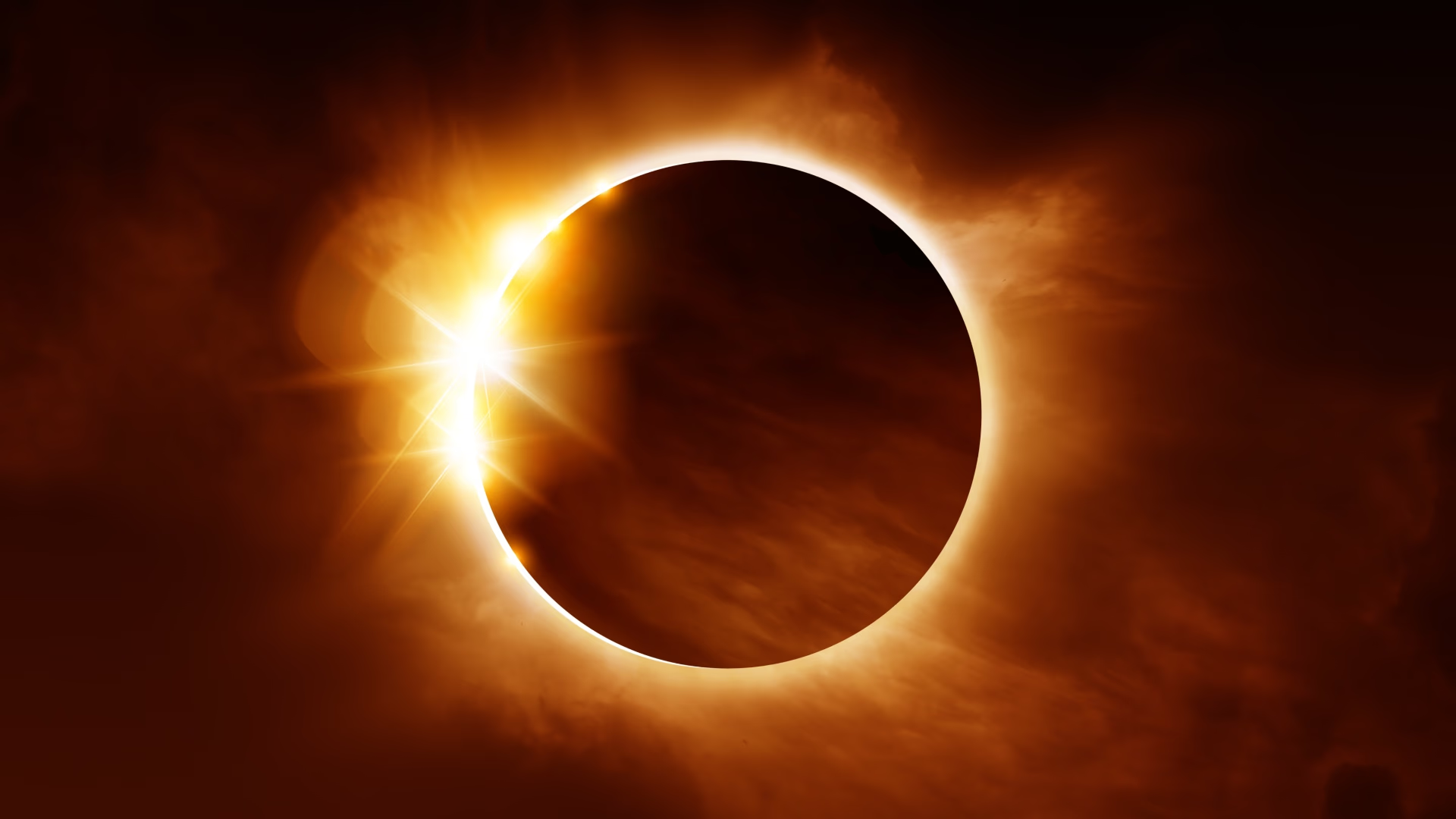
One essential point must be clearly understood: 99% is not totality. However dramatic the coverage, Alicante will not see the solar corona, stars in the daytime sky, the diamond-ring effect, or complete darkness. The gap between 99% and 100% is not a matter of degree — it is a wholly different experience. If you can travel into the band of totality, do.
Best viewing spots in Alicante
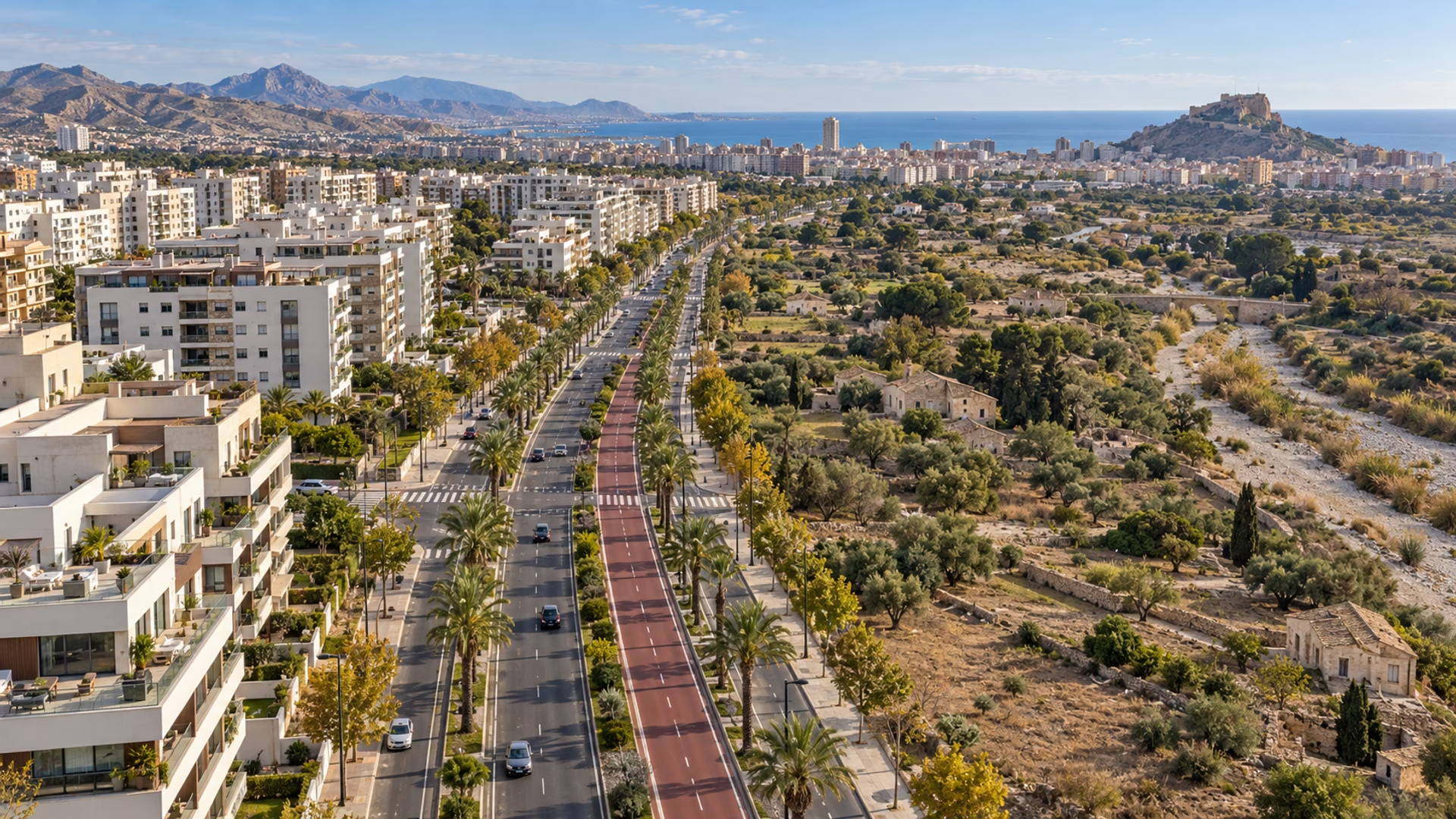
The classic viewpoint is Santa Bárbara Castle, on the hill above the city. Arrive early to secure a position with a clear sightline to the west-northwest: with the sun at 4–5°, any building, ridge or layer of coastal haze in that direction can block it entirely. Elevated spots on the Playa de San Juan side with an open view towards the Cabezón de Oro mountains also work well.
To scout your exact spot, use the treseclipses.es planner — an interactive map built for Spain's 2026–2028 eclipse trio that simulates the sun's exact path across the sky from any point you choose, so you can check in advance whether your horizon stays clear at 20:34.
Closest Places for Totality
Valencia
The closest option, roughly 170 kilometres away. The city falls right on the southern edge of the totality path, with around 60 seconds of darkness and the sun at approximately 4° above the horizon. The eastern shore of the Albufera Natural Park offers spectacular views of the eclipsed sun setting over water.
Zaragoza
At around 450 kilometres, statistically the strongest bet for clear skies: the Ebro valley records some of the highest sunshine hours in the country, and totality lasts around 83 seconds.
Burgos and Palencia
Near the central line, with the longest totality on the mainland — around 104 seconds — flat, open horizons and good cloud statistics.
Mallorca and Ibiza
Both islands fall within the totality path. From the west-facing shores of Mallorca, the image of totality over the Mediterranean promises to be extraordinary; on Ibiza, the sunset-famous beaches of Cala Comte and Cala d'Hort — with Es Vedrà in the frame — will be hard to match. Both islands are accessible by ferry from Dénia, about 90 km up the coast.
Eclipse Fever: What It Has Done to Hotels and Rentals
The travel numbers around the eclipse are remarkable. According to idealista/news, hotel bookings in inland Spain along the path have jumped by up to 500%, and Airbnb has reported an 830% surge in searches for stays along the totality band. In Ribadeo (Galicia), tourist flats have been listed at over €5,000 for the single night. Spain expects around 446,700 additional visitors during eclipse week, worth an estimated €347.6 million to the economy.
For anyone watching from the Costa Blanca, the practical consequence is simple: accommodation inside the band is effectively gone, so plan to drive there and back the same evening — and leave early.
Safety & Preparation
- Observers in Alicante need a completely unobstructed western horizon — the sun will be very low
- Anyone driving north for totality should leave well in advance: roads towards Valencia and Zaragoza will be heavily congested, and traffic authorities expect the busiest evening of the summer
- August heat means water and sun protection are essential — you may be waiting in full sun for hours
- Eye safety is non-negotiable: throughout the partial phases — which is all that Alicante will experience — ISO 12312-2 certified eclipse glasses must be worn at all times
- Only during the seconds of full totality, and only inside the totality zone, is it safe to look at the sun with the naked eye
Quick Answers
What time is the eclipse in Alicante?
It begins at 19:40, reaches maximum — 99% coverage — at 20:34, and the sun sets still eclipsed at around 20:59 on 12 August 2026.
Will Alicante see total darkness?
No. Alicante sees a 99% partial eclipse. The corona and true darkness are visible only inside the totality band, which passes just north — Valencia is the nearest major city inside it.
Where is the nearest totality to the Costa Blanca?
Valencia (~170 km, ~60 seconds of totality). For better weather odds, Zaragoza; by ferry, Mallorca or Ibiza.
Do I need eclipse glasses?
Yes — ISO 12312-2 certified glasses for the entire event in Alicante. There is no safe moment to look at a partial eclipse with the naked eye.
When is the next solar eclipse in Spain?
Soon: on 2 August 2027 another total eclipse crosses southern Spain — that one favours Andalusia. 2026 and 2027 together are Spain's eclipse double.