New-build housing prices in Spain were already rising through 2025 and into the start of 2026 — that part of the story is well established. The structural drivers behind that growth are familiar: the housing deficit, planning and permitting bureaucracy, foreign demand exceeding local supply, labor cost pressure. None of those have eased.
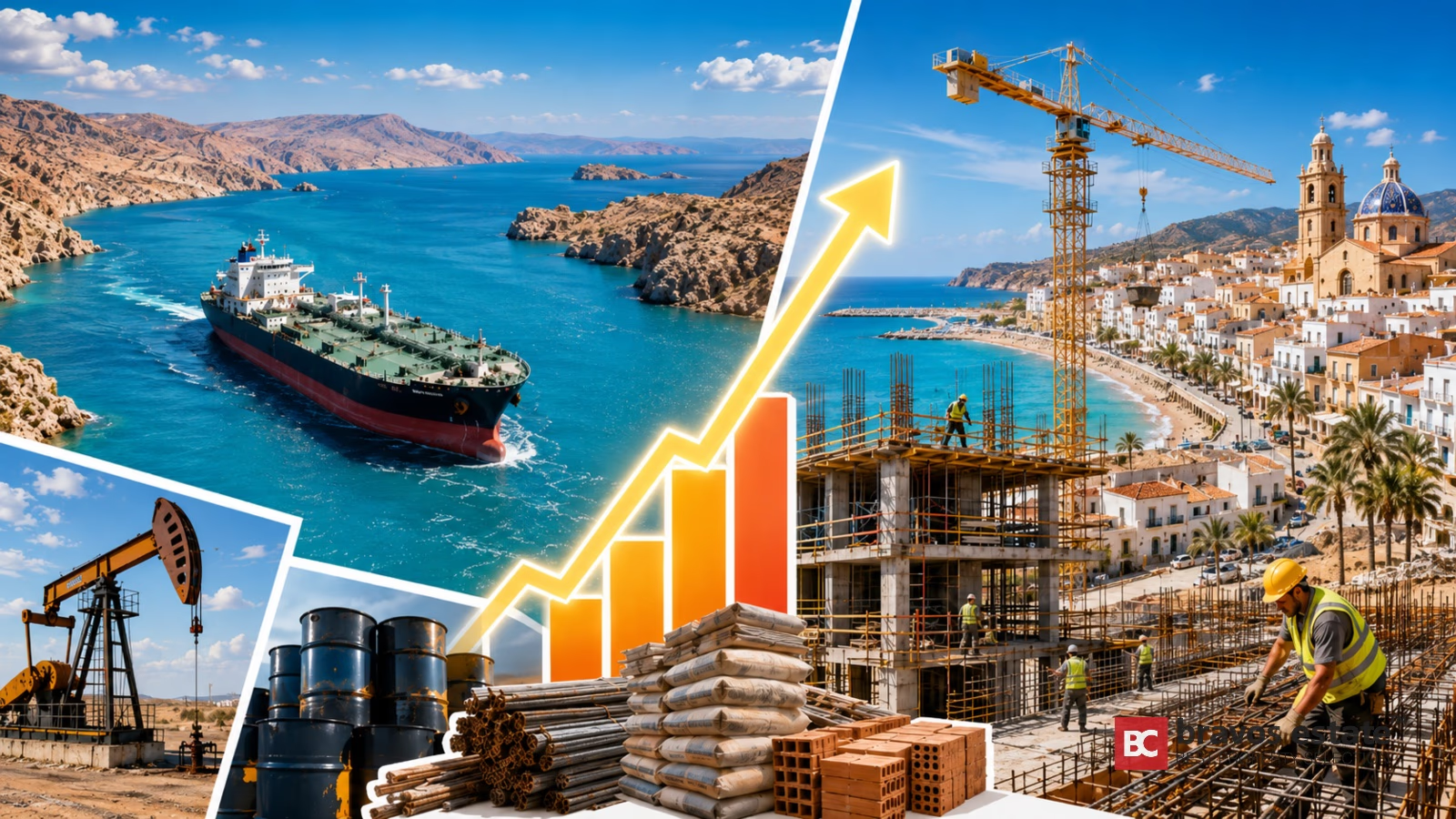
As of mid-March 2026, a new driver started layering on top of all of them: the sharp move in energy prices following the US–Israel war against Iran. Spanish developers were quietly recalculating cost models within weeks. Two months later, the same forecast is now public — across the CNC sector report (covered by Idealista, 19 May 2026), BBVA Research, Tinsa, Valmesa and Gloval Analytics.
The Iran trigger is not the main reason new-build prices are going up. It is the latest addition to a list that was already long.
The signal arrived in industry conversations first
Two patterns showed up in March–April 2026, before any of this became a public-facing story. The first was developer pricing committees revisiting current cost models within weeks of the initial energy spike — long enough to recalculate, short enough that public price lists hadn't moved yet. The second was a quiet shift in language at sales meetings on the Costa Blanca: "current pricing" stopped being framed as the standard offer and started being framed as a window. Neither was alarming on its own. Both were consistent with a market in which the input cost curve had bent and management already knew which way the next price list was going.
By early May, those private signals showed up in public data.
What the May data made public
The Confederación Nacional de la Construcción survey gave the first systematic read of how the Iran conflict has hit Spanish construction in real time:
- 90% of firms directly affected by the conflict
- More than 60% of firms report fuel costs up over 20%; one in four over 30%
- 83% of firms face electricity prices up to 20% higher
- 80% of contractors cannot pass these costs through to clients under existing fixed-price contracts
That last number is the load-bearing one. Existing fixed-price contracts get absorbed by developers — but the cost basis for the next tranche of projects, those being designed and priced now, is already being rewritten upward.
Independent forecasts are converging
What is unusual about this cycle is that analysts who normally disagree on direction are agreeing on it. Only the magnitude is in question:
- Valmesa (moderate-conflict scenario): new-build construction costs +7–12%
- Gloval Analytics, in its report "Del Petróleo al Metro Cuadrado": +6–10% to construction costs
- Developer internal estimates: raw materials already +9–12% in the first month of the conflict
- BBVA Research: +10% to housing prices in 2026, +7% in 2027 — and that forecast was issued before the Iran factor was visible
- Tinsa: new-build already up 10.4% in 2025, to €2,567/m²
- Sociedad de Tasación: m² price at end-2025 reached €2,085, the highest reading since December 2007
When BBVA, Valmesa, Gloval, Tinsa, CNC and Sociedad de Tasación all point the same way, the disagreement collapses from "is it going up" to "how fast".
The drivers that were already there
The Iran trigger landed on a market that was already structurally tight, and on a price curve that was already moving up. The pre-existing drivers — none of which have eased — are:
- The housing deficit. Banco de España estimates a 700,000-unit gap; BBVA Research puts accumulated unmet demand from 2021–2025 at 625,000 units.
- Planning and permitting bureaucracy. Spanish urban-planning approval cycles routinely run several years per project, restricting the rate at which new supply can come on-line and amplifying the response of prices to demand shocks.
- Labor cost pressure. The ACR construction-cost index recorded +5.46% in 2025 from labor shortages alone — before any energy effect.
- Tightening mortgage cycle. Euríbor recorded its biggest daily jump in nearly 20 years on 10 March 2026. Variable-rate mortgages are repricing — up to €300 per year extra on a typical loan.
- Foreign demand exceeding local supply on the Mediterranean coast, particularly the Costa Blanca.
The Iran energy shock did not start the price increase. It joined a list of drivers that were already moving prices up — and added a sharper short-term acceleration to a curve that was already pointed up.
Costa Blanca: the coast where this lands hardest
National figures understate what is happening on the Mediterranean coast — and inside the Mediterranean picture, the Costa Blanca is where foreign demand most clearly exceeds local supply.
- Alicante: €1,863/m², +12.9% in a single quarter (Olive Press, April 2026)
- Valencia: €1,677/m², +20.4%
- 16 municipalities in Alicante province are now on Idealista's top-demand list — more than Málaga, Barcelona or Murcia
- In Benidorm, Marbella and Torrevieja, the Tinsa effort-to-buy ratio exceeds 80% of disposable resident income — meaning local buyers are increasingly priced out, and the marginal buyer setting prices is foreign
- Foreign buyers already pay 75% more per m² than Spanish residents (Council of Notaries data)
When the marginal buyer in a constrained market is international and price-tolerant, the price floor moves up faster than national averages suggest. The Costa Blanca is the clearest example of this dynamic in 2026.
What this means for the buyer
Pre-sales under current contracts are the last pre-shock prices. Units now in early or mid-construction — those with reservations open — were priced under contracts signed before the energy reset. The same developments, repriced for projects being designed today, will reach the market in 2027–2028 at the recalculated cost base. Current price lists won't reappear. The new-build property guide walks through how off-plan reservation mechanics work at this stage.
Resale is not a workaround. Tinsa's data shows resale prices up +11.9% in 2025, as demand overflows from the constrained primary market into existing stock. There is no second-best segment to retreat into.
Cash buyers gain leverage at the margin. A higher Euríbor cools the fully-leveraged segment of buyers. Cash buyers and those with large down payments have more negotiating room now than they had a year ago, even as headline prices rise. This is one of the few places where the cost shock cuts the buyer's way.
The entry stage matters more than the asset. For a foreign buyer evaluating the Costa Blanca, entering at the construction or reservation stage — before developers reprice — is the rational play. Buying off-completion at "current pricing" in 2027 means buying at the new cost base.
The read on 2026
The notable thing about this period is not that one forecast is bullish on prices. It is that every independent source — BBVA, Valmesa, Gloval, Tinsa, CNC, Sociedad de Tasación, Banco de España on the deficit side — points the same way. The remaining disagreement is on pace and magnitude, not direction. And the structural drivers that were already pushing prices up have not eased: the deficit, the bureaucracy bottleneck, the labor squeeze, and the foreign-buyer marginal pricing effect on the coast are all still in place. Iran-driven energy costs are an additional layer on top of all of them, not a replacement for them.
The standard "wait until things clear up" advice is a winning strategy only if you expect prices to fall. Every independent indicator we can read points the other way.
The entry window at pre-shock terms is still open. It narrows every quarter.