Costa Blanca has just won Spain's 2026 Blue Flag race. Provincia Alicante claimed 95 awards — more than any other province in the country — when the Foundation for Environmental Education (FEE) and its Spanish partner ADEAC published the full results on 5 May 2026. Reporting on the announcement was carried by The Olive Press, Idealista, and TodoAlicante, all citing the same FEE/ADEAC release.
For anyone considering a coastal purchase, that number is the clearest quality signal of the year. Blue Flag status is not a marketing badge — it is a technical certification requiring verified water quality, beach management standards, environmental education provision, and accessible safety services, assessed annually against European benchmarks. A province that holds more of these awards than any other in Spain is telling buyers something concrete about infrastructure, municipal investment, and coastal stewardship on the ground.
Costa Blanca on top — the 2026 numbers
Spain added 33 beach awards in 2026 to reach 677 Blue Flag beaches, with total distinctions including marinas reaching 794, according to ADEAC. Within that national picture, the Comunitat Valenciana took 174 distinctions — up 10 on 2025 — accounting for 22 per cent of the entire national total and ranking first among all autonomous communities. Alicante province, which covers the Costa Blanca's roughly 244-kilometre coastline, contributed 95 of those awards, leading every other Spanish province.
Key insight: Alicante province's 95 Blue Flag beaches place it ahead of every province in Andalucía — a region that collectively holds 143 awards across eight provinces. No single Andalusian province comes close to matching Alicante's total.
| Geography | Blue Flag beaches 2026 | Change vs 2025 |
|---|---|---|
| Spain (national) | 677 | +33 |
| Comunitat Valenciana | 174 distinctions | +10 |
| Provincia Alicante (Costa Blanca) | 95 | Provincial leader |
Top municipalities in Alicante province
Blue Flag award distribution by municipality highlights the breadth of certified coastline across Costa Blanca. Orihuela holds 10 beaches and one port, making it the outright frontrunner; its coastline — marketed as Orihuela Costa — runs through Punta Prima, La Caleta, La Glea, and Cala Capitán, among others. The area sits firmly in the volume market, dominated by modern apartments and townhouses, and has historically attracted Northern European buyers seeking accessible entry points to the Spanish coast.
Dénia follows with seven Blue Flag beaches and two marinas. Its combination of long sandy family stretches at Las Marinas and the rockier, snorkelling-friendly Las Rotas reflects a wider range of buyer profiles — coastal apartments through to inland villas — placing it in the mid-to-premium bracket. Torrevieja comes next with six beaches and three ports, a volume that underlines the scale of its certified coastline; property there spans a wide range from budget apartments to seafront homes.
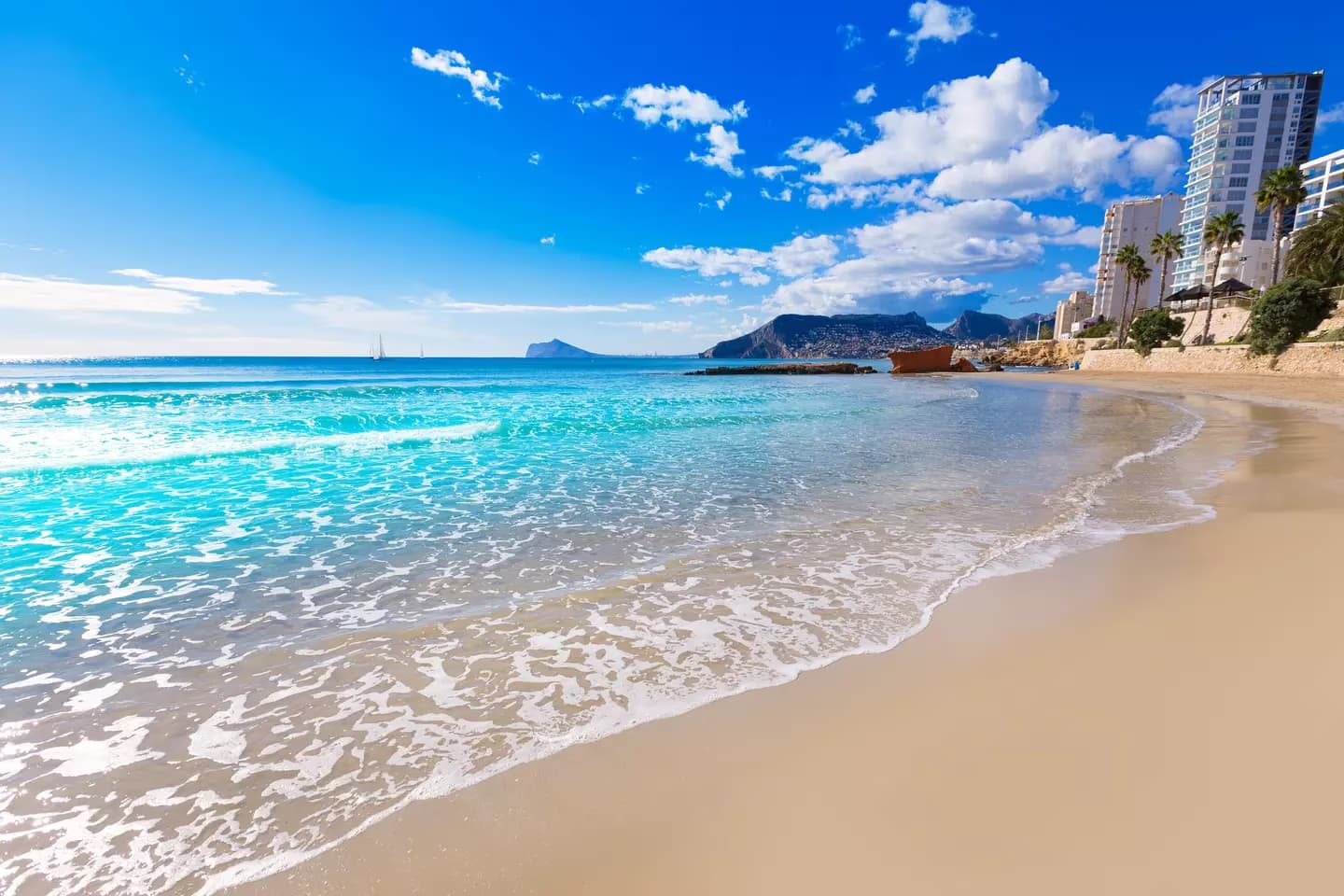
Calpe holds five Blue Flag beaches — Cantal Roig, La Fossa, L'Arenal-Bol, Puerto Blanco, and Racó — with two of those (Puerto Blanco and Racó) newly certified in 2026. Altea holds four certified beaches (Cap Blanch, El Bol, La Roda, and L'Espigó, the last of which returned to the list in 2026), establishing the premium northern corridor between these two municipalities as one of the strongest concentrations of certified coastline on the Costa Blanca. Alicante city also holds four Blue Flag beaches: Postiguet, Saladar-Urbanova, Sant Joan, and Tabarca. El Campello's three certified beaches include Cala Lanuza, which received its first-ever Blue Flag in 2026, alongside Carrer de la Mar and Mutxavista.
| Municipality | Blue Flag beaches | Marinas | Property profile |
|---|---|---|---|
| Orihuela | 10 | 1 | Volume market — apartments and townhouses |
| Dénia | 7 | 2 | Mid-to-premium — coastal apartments and inland villas |
| Torrevieja | 6 | 3 | High-volume — wide range from budget to seafront |
| Calpe | 5 | — | Mid-tier with premium pockets near headlands |
| Altea | 4 | — | Premium villa market with seafront apartments |
| Alicante | 4 | — | Urban premium — Sant Joan and central districts |
| El Campello | 3 | — | Mid-tier authentic Mediterranean coastal town |
Further north, the combined tally from the Marina Baixa comarca and Calpe reaches 18 awards — a concentration that reflects the density of certified coastline between Benidorm and the Peñón de Ifach headland. Calpe in particular punches above its size, with multiple distinct beach environments within a compact municipal boundary.
What changed in 2026 — newcomers and returners
Four beaches earned their first-ever Blue Flag in 2026. L'Advocat in Benissa and Puerto Blanco and El Racó in Calpe all join the certified list for the first time, adding to an already strong northern corridor showing. The fourth newcomer is Cala Lanuza in El Campello.
El Campello deserves slightly more attention than it typically receives in these announcements. Situated on the northern edge of the Alicante urban area, it is one of the few stretches of Costa Blanca that remains genuinely and primarily Spanish in character — less saturated with international tourism than Benidorm to the north, and more affordable and relaxed than the premium residential neighbourhoods around San Juan beach. Its coastline already held Blue Flags at Muchavista, Carrer la Mar, and Coveta Fumà. Cala Lanuza's first certification in 2026 is a quiet but meaningful validation: a small cove that has met the full suite of European water quality and management criteria without the promotional machinery that surrounds larger resorts. For buyers looking at the mid-tier coastal apartment market with genuine local infrastructure and improving beach credentials, El Campello is increasingly difficult to overlook.
Three beaches returned to the Blue Flag list in 2026 after absences in previous years. L'Arenal in Jávea and L'Espigó in Altea — both in the premium northern corridor — regained their flags, as did Tamarit in Santa Pola, which sits in the budget-to-mid segment to the south of Alicante city.
One loss is worth noting. Cala Fustera in Benissa did not retain its Blue Flag for 2026. Blue Flag requires sustained compliance — water quality sampling, waste management, and staffing standards must all be met continuously. A single failed annual assessment is enough to remove a beach from the list, which is precisely what gives the certification its credibility. The loss at Cala Fustera does not reflect a structural deterioration but serves as a reminder that the award is re-earned each year, not held in perpetuity.
Why Blue Flag matters for property buyers
The certification has three concrete implications for anyone purchasing coastal property on Costa Blanca.
- Rental performance. Certified beaches generate stronger short-term rental demand. Guests booking holiday accommodation actively filter by beach quality, and Blue Flag status — widely recognised across Northern European source markets — functions as a legible proxy for water safety and cleanliness. Properties within walking distance of a certified beach consistently attract higher occupancy and nightly rates in the holiday let market.
- Resale liquidity. Secondary market data consistently shows that proximity to a Blue Flag beach is priced into buyer expectations, particularly among international purchasers from Germany, the Netherlands, Scandinavia, and the UK. When a previously uncertified beach gains Blue Flag status — as Cala Lanuza has in 2026 — the surrounding residential catchment benefits from an upward recalibration of perceived quality.
- Public investment signal. Municipalities that maintain Blue Flag status over multiple years are demonstrating sustained public spending on coastal infrastructure: water treatment, lifeguard provision, accessible facilities, and environmental monitoring. That pattern of municipal investment is a reasonable leading indicator of ongoing public realm maintenance — something that matters to long-term owners rather than just holiday visitors.
For a broader view of how these coastal areas compare, see the Costa Blanca regions overview, or browse current listings across the province.
What to watch for the rest of 2026
Blue Flag awards are assessed annually, and the 2026 list will be the baseline against which next year's results are measured. The trajectory for Alicante province is upward — 95 awards represents a multi-year accumulation of improving infrastructure and environmental standards, not a one-off result. The question for the remainder of 2026 is whether the municipalities that gained flags this year can maintain compliance through the peak summer season, when pressure on beach management systems is at its highest.
The geographic pattern of this year's newcomers is also worth noting. L'Advocat, Puerto Blanco, El Racó, and Cala Lanuza all sit in the northern corridor between Alicante city and the Marina Alta comarca — exactly the stretch of coast where international buyer enquiries have been rising most consistently. When new Blue Flag certifications cluster in the same areas where demand is building, the two trends reinforce each other. That convergence, more than any individual award, is the structural story of Costa Blanca's 2026 season.
For a complete look at where these beaches sit and which Costa Blanca areas to live in nearby, see our complete guide to the best beaches on Costa Blanca.