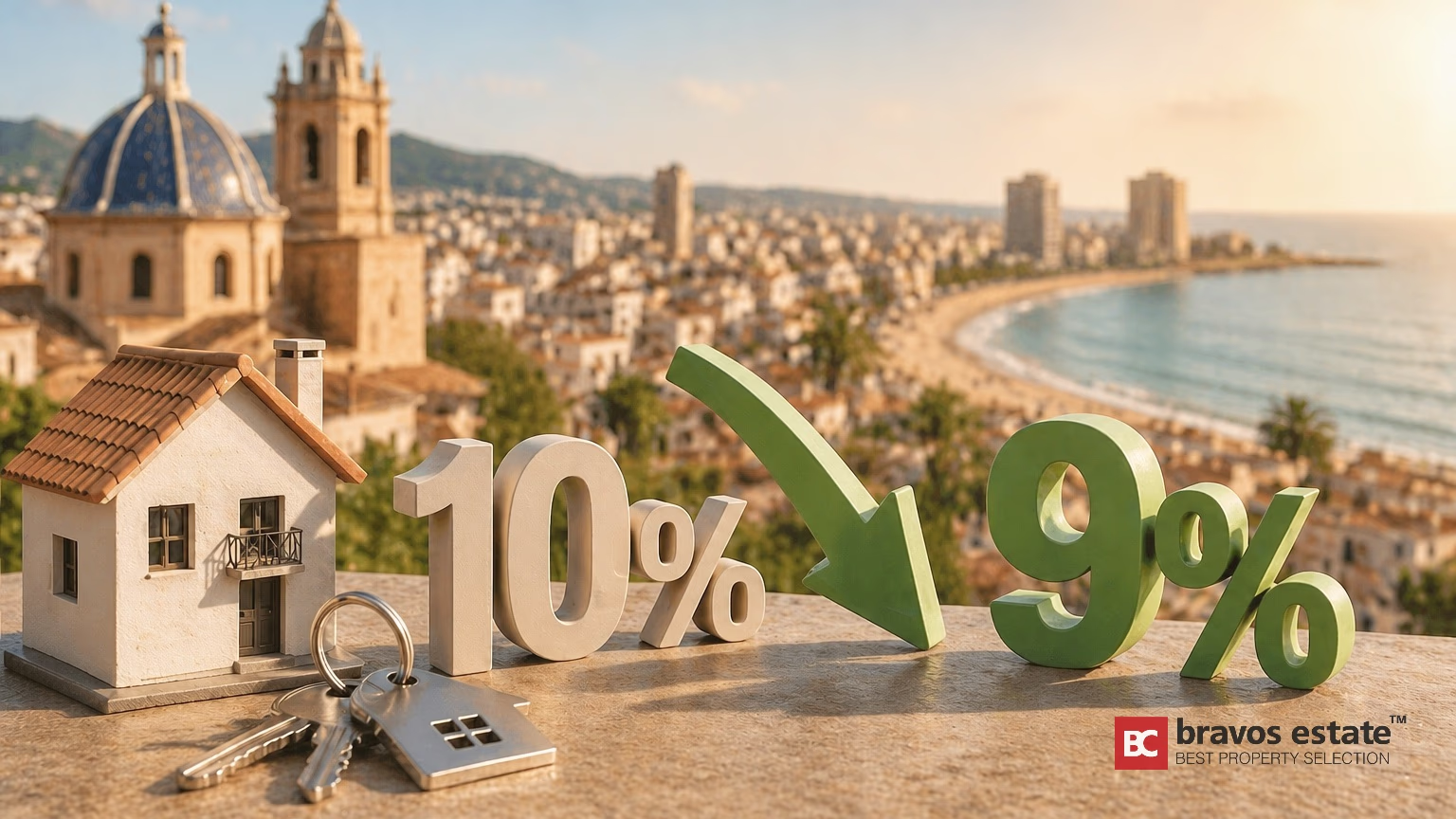
From 1 June 2026, the Comunidad Valenciana — the Spanish region that includes the entire Costa Blanca — drops its general property transfer tax (ITP) from 10% to 9%. Stamp duty (AJD) on related deeds falls from 1.5% to 1.4% on the same date. For most Costa Blanca buyers — Alicante, Torrevieja, Jávea, Calpe, Dénia, Altea — that is a one-percent permanent reduction in the largest single tax line of any used-home purchase. Here is how the reform actually works, who benefits, and what changes for buyers planning a 2026 deed.
The reform comes from Law 5/2025 of 30 May, approved by the Cortes Valencianas and published in the regional gazette on 31 May 2025. It is not a discretionary discount or a temporary measure: it is a permanent statutory rate change with a clear effective date.
What Changes on 1 June 2026
Three numbers move:
- General ITP rate: 10% → 9% on used residential property purchases
- AJD (stamp duty): 1.5% → 1.4% on notarial deeds (mortgage, division, grouping)
- Properties valued above €1,000,000: the special 11% bracket is unchanged
What does not change: VAT on new-build homes (still 10% + 1.4% AJD from June), the existing reduced ITP rates for specific buyer profiles, and the rules for primary-residence vs investment property.
Key date rule: what matters is the date of the notarial deed (escritura pública), not the date of the reservation contract or private purchase agreement. A buyer who reserves in March 2026 but signs at the notary on or after 1 June 2026 pays the new 9% rate.
The Numbers in Practice
For a foreign buyer purchasing a used apartment or villa on the Costa Blanca, this is the line-by-line saving on a typical price ladder:
| Used home price | ITP under old 10% | ITP under new 9% | You save |
|---|---|---|---|
| €150,000 | €15,000 | €13,500 | €1,500 |
| €250,000 | €25,000 | €22,500 | €2,500 |
| €350,000 | €35,000 | €31,500 | €3,500 |
| €500,000 | €50,000 | €45,000 | €5,000 |
| €750,000 | €75,000 | €67,500 | €7,500 |
| €999,000 | €99,900 | €89,910 | €9,990 |
| €1,200,000 | 11% = €132,000 | 11% = €132,000 | €0 (over €1M cap) |
On top of that, mortgage deeds get the AJD cut. On a €300,000 mortgage liability (the figure stamp duty is calculated on, typically slightly higher than the loan principal), the saving is around €300. Modest, but real.
Who Benefits — And Who Does Not
Buyers who fully benefit
The reform mostly helps the broad mid-market, which is the heart of foreign-buyer demand on the Costa Blanca:
- Buyers of used apartments and villas under €1,000,000 — Torrevieja, Guardamar, Santa Pola, Punta Prima, La Zenia, Ciudad Quesada, Cabo Roig and most of the southern Costa Blanca fall here
- Buyers in Alicante city, where the average price is around €317,000 — see our Q1 2026 Alicante demand analysis
- Buyers in mid-tier coastal markets — Calpe, Moraira, Benissa, Dénia, El Campello, Villajoyosa, Benidorm and Finestrat — where the bulk of resale stock sits well below the €1M threshold
Buyers who do not benefit (or only partially)
- Buyers of new-build property. New builds pay VAT (IVA), not ITP. The 10% VAT rate is set by Spanish national law, not by Valencia. For context, see our new-build property guide.
- Buyers above €1,000,000. The 11% rate above €1M is preserved. This affects luxury segments — much of Altea Hills, the higher end of Jávea, premium villas in Moraira, and certain plots in Cumbre del Sol and Las Colinas.
- Buyers who already qualify for a reduced rate. The pre-existing reduced ITP rates of 8%, 6%, 4% and 3% — for first-home buyers under 35, large families, persons with disability and certain depopulation-risk municipalities — were already below the new 9% headline rate. They remain unchanged.
The €1,000,000 Threshold — A Real Inflection Point
The reform creates a sharper cliff at €1M than existed before. Below €1M: 9%. Above €1M: 11%. Critically, the 11% applies to the full transaction value, not just the amount above €1M (it is a cliff threshold, not progressive). On a €1.05M deal, the ITP is €115,500 — roughly €25,590 more than the €89,910 a €999,000 deal would pay. Of that gap, €21,000 is the pure cliff penalty (paying 11% instead of 9% on the same €1.05M). The threshold is calculated on the declared deed value (not the cadastral reference value, though the tax authority uses the higher of the two for valuation purposes — see our property tax guide).
For buyers shopping in the €950K–€1.05M range, structuring the transaction below €1M (where genuinely possible) becomes more meaningful in 2026 than it was before. This is one to discuss with your lawyer, not to attempt unilaterally.
The AJD Cut — Smaller, but Universal
Stamp duty (Actos Jurídicos Documentados) drops from 1.5% to 1.4%. AJD applies to:
- Mortgage deeds — paid by the bank in Spain since 2018, but reflected in your effective borrowing cost
- New-build purchase deeds — paid by the buyer, on top of 10% VAT
- Property division, grouping, declaration of new construction — relevant if you are subdividing a plot or registering an extension
For a used-home buyer financing the purchase, the AJD cut shaves around €100 per €100,000 of mortgage deed. For a new-build buyer, it is a direct saving on the deed: €1,000 less on a €1M new-build, for example.
What About Existing Reduced Rates?
The Comunidad Valenciana has a layer of reduced ITP rates that already exist and are not affected by the headline reform:
- 3% — habitual residence purchases up to €180,000 by large families (familia numerosa) or persons with a recognised disability ≥33%
- 4% — habitual residence purchases by women victims of gender violence; certain rural/agricultural land transactions
- 6% — first habitual residence by buyers under 35 years old, up to €180,000 of property value, subject to income conditions
- 8% — habitual residence acquisitions by young entrepreneurs of business premises
If you already qualify for one of these — typically Spanish residents, but some apply to non-residents who relocate — the new 9% headline rate is irrelevant: your reduced rate is still better. For most foreign buyers purchasing a second home or investment property, the 9% general rate is the one that applies.
How This Reshapes the Used vs New-Build Calculation
Until now, the headline tax math broke down as follows on the Costa Blanca:
- Used home: 10% ITP + small notary/registry costs ≈ ~10.5% in transfer taxes
- New build: 10% VAT + 1.5% AJD ≈ ~11.5% in transfer taxes
From June 2026:
- Used home: 9% ITP ≈ ~9.5% all-in
- New build: 10% VAT + 1.4% AJD ≈ ~11.4% all-in
The gap between used and new widens by about one percentage point in favour of used homes. For buyers indifferent between an off-plan in Cumbre del Sol and a resale in Jávea, this changes the after-tax math meaningfully — particularly when combined with lower price points typical of the resale market. Read our full breakdown of the costs of buying property in Spain for the complete picture.
Should You Wait Until June 2026 to Sign?
If your purchase is genuinely flexible on timing, yes — waiting to sign your deed on or after 1 June 2026 saves you 1% of the purchase price on a used home. On €400,000, that is €4,000 — meaningful enough to factor in.
The realistic counter-arguments:
- Price drift. Costa Blanca prices have been firm through Q1 2026. A few months of waiting could see asking prices move up by more than 1% on the right property — eroding or eliminating the tax saving.
- Inventory risk. Specific properties are illiquid. The villa or apartment you want today may not be available in June.
- Mortgage conditions. ECB rates and Spanish mortgage spreads are not static. A 0.25 pp move in mortgage rate over the same period would dwarf a 1% ITP saving on a long-tenor loan.
If you are already in a private contract with a closing date scheduled before 1 June 2026, in many cases it is feasible to amend the closing date to early June — but only if both seller and buyer agree, and only if the existing contract clauses allow it. Discuss it with your lawyer before raising it with the seller.
What Costa Blanca Buyers Should Do Now
- If you are deed-ready and your transaction is largely complete: in many cases, signing now still makes sense. The 1% is meaningful but rarely large enough to risk losing the property or letting the seller relist.
- If you are early in your search and looking at used homes under €1M: there is no reason to rush a deed before June. A signing in June or later automatically captures the lower rate.
- If you are looking above €1M: the reform does not help you. Focus on the property-specific factors. See our Altea & Altea Hills area page and our guide to the most beautiful coastal towns of the Costa Blanca for context.
- If you are buying new-build: the ITP cut does not affect you, but the AJD cut shaves a small amount. The bigger question is whether a comparable used home becomes more attractive on an after-tax basis.
- If you may qualify for a reduced rate: talk to a Spanish tax advisor before assuming the 9% rate applies. For young buyers under 35 and large families purchasing a primary residence under €180,000, much better rates already exist.
Bottom Line
The Comunidad Valenciana's ITP cut is a permanent, statutory 1-percentage-point reduction in the largest single tax line on most Costa Blanca property purchases. Below €1M, every used-home buyer benefits. The reform is not designed to revolutionise the market — it is a competitive alignment with neighbouring autonomous communities such as Madrid and Andalucía, both of which already have lower transfer taxes. But on a €500,000 purchase, €5,000 is real money, and it shifts the relative math between resale and new-build in favour of the resale market.
For a complete picture of how this fits into the broader cost of buying property in Spain, see our 2026 cost guide, our step-by-step buying guide, and our Spain property market forecast 2026. If you are weighing specific Costa Blanca locations, our best areas to buy on the Costa Blanca guide covers the trade-offs by buyer profile.