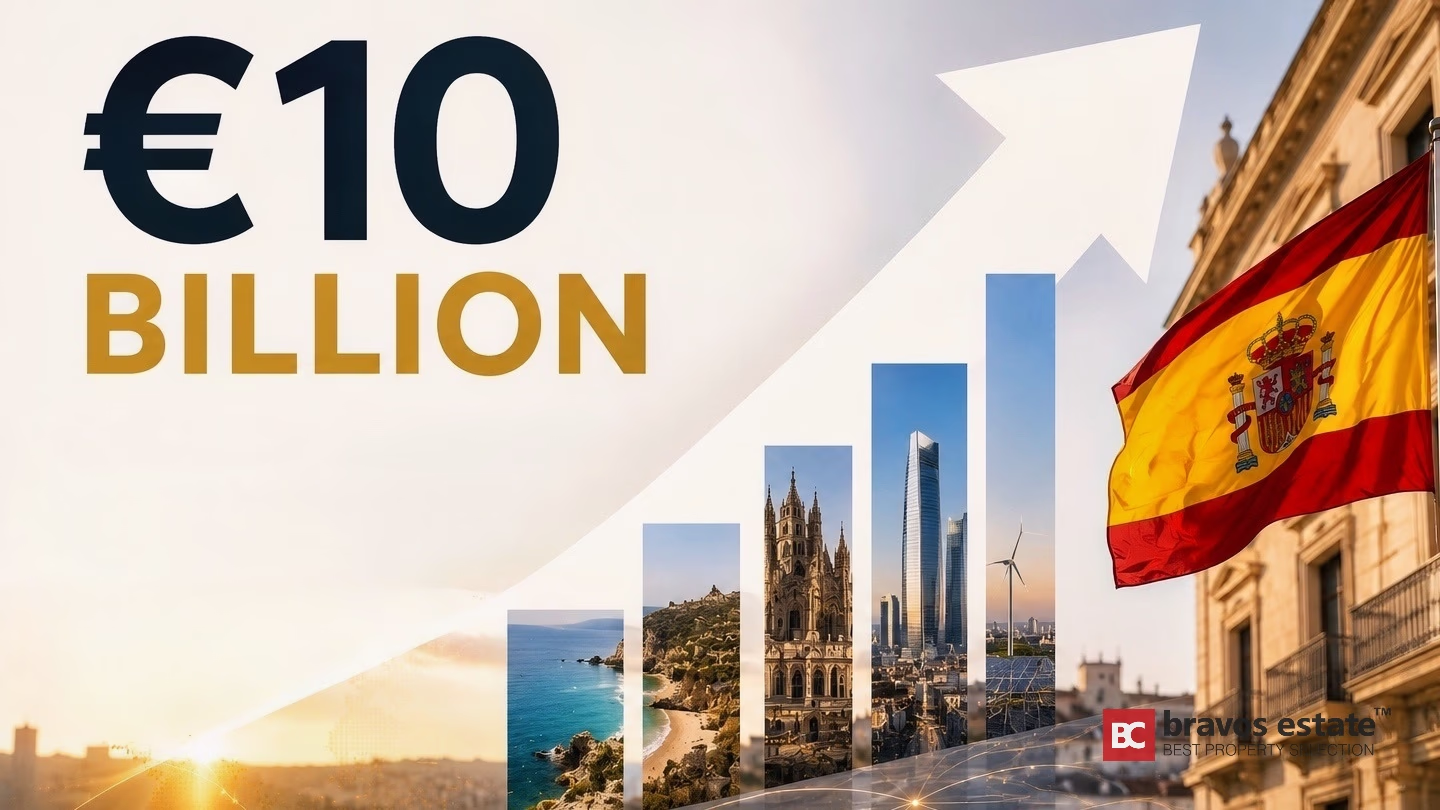
Spain's property market delivered a six-month number that almost no analyst saw coming. According to preliminary data from JLL, real estate investment in the first half of 2026 reached €10.052 billion — already above the full-year record set in 2022 and up 50% year on year. The figure could climb further once pending transactions are booked, notably Nuveen and King Street's €330 million acquisition of the Bravo residential portfolio.
The capital is institutional and increasingly international. Canadian pension giants Brookfield, Hoopp and Omers sit alongside Spanish vehicles Azora, Criteria, Calena Partners and Castellana Properties. Atrea Real Estate, the new vehicle of Luis López de Herrera-Oria, has joined the list of active buyers. For an individual buyer weighing a villa on the Costa Blanca or an apartment in Mallorca, the question is no longer whether the rally is real — it is what €10 billion of institutional conviction means for the price of the front door you are about to walk through.
Q1 closed at €6.3 billion, the third-best quarter on record (analysed in our Q1 2026 breakdown). Q2 added another €3.75 billion — acceleration, not fatigue. The €10B mark with two weeks of June still on the clock is the clearest signal in years that professional capital has decided where European real estate is heading.
Who are institutional investors: pension funds, insurance companies, sovereign wealth funds, private equity firms, listed REITs (SOCIMIs in Spain) and large family offices. They manage other people's money — pension savings, insurance reserves, the wealth of states and dynasties. Tickets start at tens of millions of euros, which is why they don't buy single villas or apartments: the minimum unit is an entire residential complex, a hotel portfolio or a retail park. That is precisely why their arrival is a signal — each transaction is preceded by months of due diligence. These players don't enter falling markets.
The H1 2026 picture: residential leads the cycle
The composition of the half tells you where professional capital sees durable demand. Residential — what JLL groups across rental, student, senior living and flexible apartments — was the runaway leader, capturing nearly half of every euro invested.
| Sector | H1 2026 Volume | Share of Total | YoY Change |
|---|---|---|---|
| Residential (rental, student, senior, flex) | €4.375 billion | 44% | ~ +280% |
| Offices | €1.79 billion | 18% | +5% |
| Retail (shopping centres lead) | €1.68 billion | 17% | +11% |
| Hotels | ~€1.4 billion | 14% | −14% |
| Logistics | €779 million | 8% | +21% |
| Total | €10.052 billion | 100% | +50% |
Key insight: Residential is not just the largest segment — it is growing roughly twenty times faster than offices and is the clearest signal that professional money expects Spanish housing demand to keep outrunning supply. Eight single deals in residential rentals topped €100 million each in H1 2026; the same milestone was reached only four times in all of H1 2025.
Top 5 deals of H1 2026
The headline transactions show both the size of the bets and the conviction behind them. Three of the five biggest deals are residential portfolios — a pattern that did not exist three years ago.
| Buyer | Asset | Seller | Price |
|---|---|---|---|
| Brookfield (CA) | 5,000-home residential portfolio | Blackstone | €1.05 billion |
| Hoopp (CA) | Residential portfolio | Ares | €630 million |
| Criteria | Estel office building, Barcelona | — | €385 million |
| Azora | Residential portfolio | Patrizia | €350 million |
| Castellana Properties | Islazul shopping centre, Madrid | — | €340 million |
Why Spain — and why now
According to Juan Manuel Pardo, JLL's head of Capital Markets Spain, three factors explain the surge: demographic growth above the Western European average, an economy outperforming the EU mean, and Spain's reputation for political and geopolitical stability — particularly valuable as the broader geopolitical reorganisation weighs on global capital allocation.
The deepest institutional bet sits in the rental stock. Funds are buying large portfolios with the explicit plan to segregate and resell unit by unit — what the industry calls "atomización". This is not a small detail; it is the mechanical channel through which institutional inflows reach the individual buyer over the next 12 to 24 months.
Why "atomización" matters to private buyers: when an institutional fund buys 5,000 rental homes at a portfolio price, then segregates and lists them individually over 18-24 months, the price per home is reset upward. The same villas and apartments that were absorbed in a wholesale package re-enter the market priced for retail demand. Eight residential deals over €100 million in H1 2026 means thousands of homes will be repriced in this way before the end of 2027.
What this means for the private buyer
1. Prices: institutional capital sets the floor
When €10 billion enters a real-estate market in six months, prices follow. The mechanism is not opaque: institutional buyers transact at scale, anchor the price discovery, and the same comparable trades become the reference point bank appraisers and listing agents use the following quarter. Spain's new-build prices are already up sharply in 2026 — see our analysis of why new-build prices are rising in 2026. The H1 inflow adds direct demand pressure on the segments where individuals also buy.
2. Bubble risk: the Bank of Spain says no
Strong inflows always raise the question of a bubble. The Bank of Spain's most recent assessment — covered in our breakdown of the bubble report — concludes Spanish housing is not in a bubble: fundamentals (demographics, the supply-demand gap, mortgage discipline) explain the bulk of the price gains. Institutional players betting €10 billion in six months are clearly running the same calculation. Cycles do end, but the bubble dynamic — buying because prices rise — is not present today.
3. Financing: the ECB just tightened the window
The other side of the equation is borrowing cost. With the ECB raising rates on 11 June, Euribor is climbing and Spanish mortgages will reprice upward through the second half. Variable rates re-quote in 6-12 months; fixed-rate offers in the market today still reflect the pre-decision pricing. For buyers planning to leverage, locking a fixed-rate offer in the next 4-8 weeks may matter more than waiting for the next "good deal".
4. Why Costa Blanca and Mallorca specifically benefit
Institutional residential capital concentrates in Madrid, Barcelona and the prime coastal markets. As these saturate at institutional valuations, spillover demand and lending capacity rotate to comparable secondary coastal zones — exactly where the individual buyer transacts. Costa Blanca, Costa del Sol and Mallorca are the obvious beneficiaries: established demand, ready supply, and prices that still trail the institutional comp sets by 15-25%. The bigger picture sits in our Spain property market forecast 2026.
Outlook: Q2 acceleration suggests €20B+ full year
JLL's analyst expects the figure to climb further once pending transactions are booked. If Q3 prints a comparable €4-5 billion to Q2, the full-year 2026 total will land above €20 billion — well clear of the €15-17B range most analysts pencilled in at the start of the year. That trajectory would mark Spain's second straight year as Europe's most attractive real-estate destination, ahead of the UK for the first time on a multi-year basis.
From €6.3 billion in Q1 to over €10 billion at the H1 mark, the rhythm is acceleration, not reversion. Whether this marks the top of a cycle or the early innings of a longer run, one thing is clear: the smart money has already made its call. The H1 €10B is not a signal to rush — it is a signal to stop assuming you have unlimited time.