The 2026 FIFA World Cup is under way. Spain opens its campaign on 15 June against Cape Verde in Atlanta, followed by Saudi Arabia on 21 June and Uruguay in Guadalajara on 27 June. The final is in New Jersey on 19 July.
That's the football. Here's the property angle: several of the tournament's biggest names already treat Spain's Mediterranean coast as a home base — and when the whistle blows in the US, that's where some of them head. These aren't leaked deals. Each property below has been publicly reported, often across multiple outlets, and we've kept to development and district level only — no exact addresses.
World Cup 2026 in numbers: 48 teams, 16 host cities across the United States, Canada and Mexico. Spain sits in Group H with Cape Verde, Saudi Arabia and Uruguay. The group stage runs 11–27 June; the final is on 19 July at MetLife Stadium, New Jersey. Spain's three group games are on US time — most of Europe watches in the evening.
Marbella — the Costa del Sol's football enclave
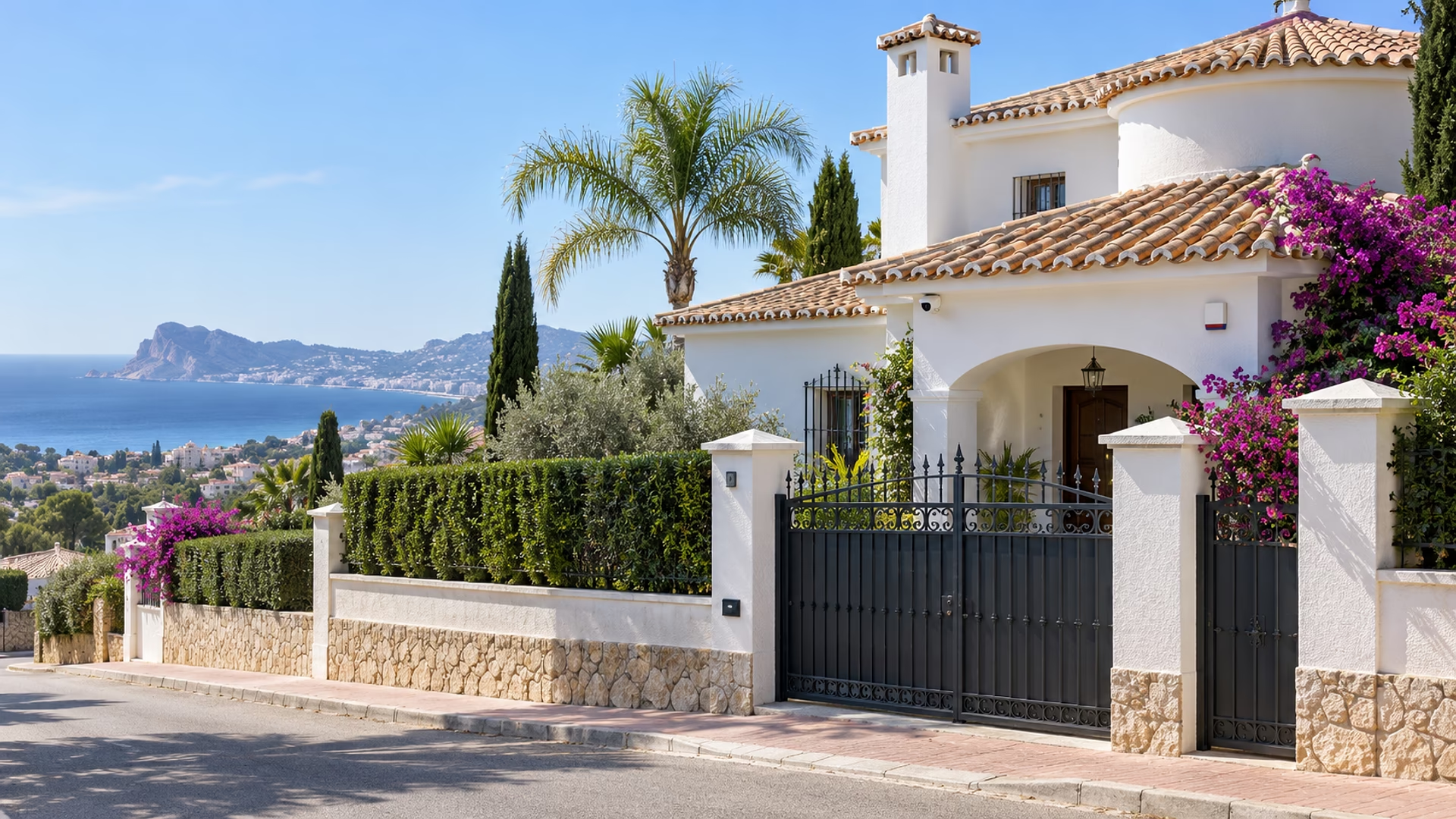
The Costa del Sol's "celebrity coast" reputation isn't just about retired film stars any more. Three players in this World Cup already own homes within a short drive of each other on the same stretch of the Andalusian Mediterranean.
Cristiano Ronaldo (Portugal) — heading to a record sixth World Cup at 41 — owns a four-bedroom villa at the Heights development on Marbella's La Resina golf estate, reportedly bought for around £1.3 million. The acquisition has been covered by outlets from the South China Morning Post to Robb Report: an infinity pool, home cinema and private gym, on a cul-de-sac where UFC champion Conor McGregor is said to be a neighbour.
Erling Haaland (Norway) leads a Norwegian side back at the World Cup for the first time since 1998. According to Robb Report and Spanish daily AS, the Manchester City striker bought into Marbella's Nagüeles district — at the foot of La Concha mountain — for a reported €6.5 million, adding to a wider Marbella connection his family has held for years.
Nico Williams (Spain) is the freshest arrival. In April 2025 the Athletic Bilbao winger was reported by The Olive Press, Euro Weekly and The Spanish Eye to have bought one of the homes in the new Marbella by Fendi development in Sierra Blanca — the enclave often called Spain's "Beverly Hills". Williams is part of Spain's squad for this tournament; whatever happens in Atlanta, his summer ends back on the Costa del Sol.
Mallorca — quieter, and not only this year's squads
If Marbella is loud, Mallorca is discreet — and its best-known football homeowner isn't actually at this World Cup. Robert Lewandowski (Poland) won't feature in 2026: Poland fell to Sweden in the European playoffs. But the Polish striker's island story is the clearest of the lot. According to The Olive Press, the Majorca Daily Bulletin and Tribuna, he owns two villas on Mallorca — the first in Santa Ponça, reportedly bought around 2021 for about €3.5 million, and a second in Camp de Mar (Andratx), added in early 2025 for a reported €11 million: roughly 700 m², six bedrooms, terraces opening onto the Mediterranean and access to secluded coves.
What's interesting isn't the price. It's the pattern. Lewandowski has reportedly holidayed on Mallorca since his Borussia Dortmund years, and a decade later — through a Barcelona spell and beyond — his presence on the island has only deepened. Missing a World Cup doesn't change where a player chooses to live.
Why Mallorca: year-round flights to most European capitals (Palma's airport handles over 30 million passengers a year), strong value retention in the beachfront segment, and a degree of privacy that Marbella's celebrity strip rarely offers. It has become a quiet favourite for footballers who want the coast without the cameras.
Why these coasts? It's not just the sunshine
You don't buy a multi-million-euro villa for the weather. The pattern across these acquisitions points to four things football's elite consistently look for:
Privacy with infrastructure. Sierra Blanca, La Resina, Nagüeles, Camp de Mar — all are gated or quasi-gated enclaves where discreet entry and private security are standard. Yet each sits within roughly 30 minutes of an international airport (Málaga or Palma), Michelin-rated dining and elite training facilities.
A stable base across club moves. Players whose careers move between leagues use a Spanish coastal home as a fixed point. Lewandowski's Mallorca decade tracks his Dortmund, Barcelona and post-Barcelona eras — the property stayed put while the clubs changed.
Capital appreciation. The record €10 billion of institutional capital that poured into Spanish property in the first half of 2026 has not spread evenly — Marbella prime and Mallorca beachfront have been among the strongest performers, with prime price growth running an estimated 8–12% year on year according to industry trackers.
Tax and residency. Spain's Beckham Law — the special regime for high-earning new residents — has featured in many athlete relocations, though recent reforms have narrowed its scope. For players early in their careers, Spanish residency anchored by real estate has long been a strategic option.
The honest read: these footballers are not exceptional buyers — they're part of a broader pattern. Marbella's prime market has been one of Europe's most resilient over the past decade, and Mallorca's beachfront has outperformed mainland Spanish averages in 2025–2026. The reason elite players cluster there is the same reason institutional capital does: liquidity, climate and asset appreciation in one product.
The same coasts — and they're not celebrity-only
It would be easy to read this and assume the Spanish coast is now a billionaires' market. It isn't. The €11 million Andratx villa and a €1.3 million Marbella townhouse sit at two ends of the same coastline, and most of the geography in between remains open to international buyers at €500K–€1.5M price points.
That's the underrated angle. When a Portuguese, Norwegian, Spanish or — in years past — Polish footballer chooses Marbella or Mallorca, they're not creating a separate market. They're buying in the same one that retirees, remote-working families and mid-tier investors compete in. The 8–12% prime appreciation behind these headline purchases is the same trend pricing a Costa del Sol penthouse or a Mallorca village house. For the broader picture, see our Spain property market forecast 2026, and our Costa del Sol vs Costa Blanca comparison for buyers weighing the two regions.
And the premium coasts aren't the only option. The same Mediterranean shoreline runs north along the Costa Blanca — Alicante, Calpe, Jávea, Torrevieja — where entry points sit far lower and where most international buyers actually start.
After the whistle
From 11 June to 19 July, the world's attention sits on stadiums across 16 North American cities. Ronaldo, Haaland and Williams will spend those weeks in hotels and team facilities thousands of kilometres from the Mediterranean. Then the football stops — and for several of them, home means a quiet stretch of the Spanish coast they've been building toward for years.
The same coast that's hosting more than €10 billion of institutional capital this year. The same coast anyone reading this can browse and buy on. The World Cup wraps up in five weeks; the Spanish summer doesn't.