British buyers now lead foreign housing demand across Spain's southern provinces — Málaga, Almería, Murcia and Granada — and in Málaga province foreigners already generate 27.1% of all purchase demand, according to idealista/data's study for the first quarter of 2026. Nationally the British numbers look modest — 7% of foreign purchases across Spain — but on the Costa del Sol that demand is concentrated, and it prices in one specific band.
A developer-side release published on 7 September 2026 confirms the same picture from the reservations ledger: at Taylor Wimpey España, Britons took 21% of Costa del Sol new-build reservations in 2026 — one in five, ahead of every other nationality on its buyer list — paying €560,000 on average, with the golf-resort product they favour starting at €400,000 plus VAT. Those figures cover reservations rather than completed sales; the national comparison is from Spain's General Council of Notaries, covering the first six months of 2026.
What a "reservation" is: in Spanish new-build practice, a reservation is a paid deposit that takes a unit off the market for a short fixed period, before the private purchase contract is signed. It is a forward indicator of demand — not a registered sale — and a share of reservations always converts out. Read it as a snapshot of who is choosing what right now, not as market share.
The numbers
The concentration is the story. A nationality that makes up roughly one in fourteen foreign buyers nationally leads market-wide demand in four southern provinces — and takes one in five reservations in a specific product on a specific coast. Two different datasets, one signal.
| Indicator | Figure |
|---|---|
| British position in foreign purchase demand — Málaga, Almería, Murcia, Granada (idealista/data, first quarter 2026) | #1 |
| Foreign share of all purchase demand, Málaga province | 27.1% |
| British share of Costa del Sol reservations (one developer, 2026) | 21% |
| Nationalities represented among that developer's buyers | about 30 |
| British share of all foreign buyers in Spain, first half of 2026 | 7% |
| Average price paid, Costa del Sol, 2025–26 | €560,000 |
| Entry price, golf-resort apartments at La Cala de Mijas | from €400,000 + VAT |
| Typical buyer | married couples aged 55–60 |
What they are actually buying
The stated priorities are narrow and consistent: golf access, sport, fitness and spa facilities on site, and — repeatedly — quiet. The second requirement is flexible interior space: a room that works as a home office or a guest bedroom, rather than a larger apartment overall. Most are buying a second home or a retirement base, not an investment unit to let.
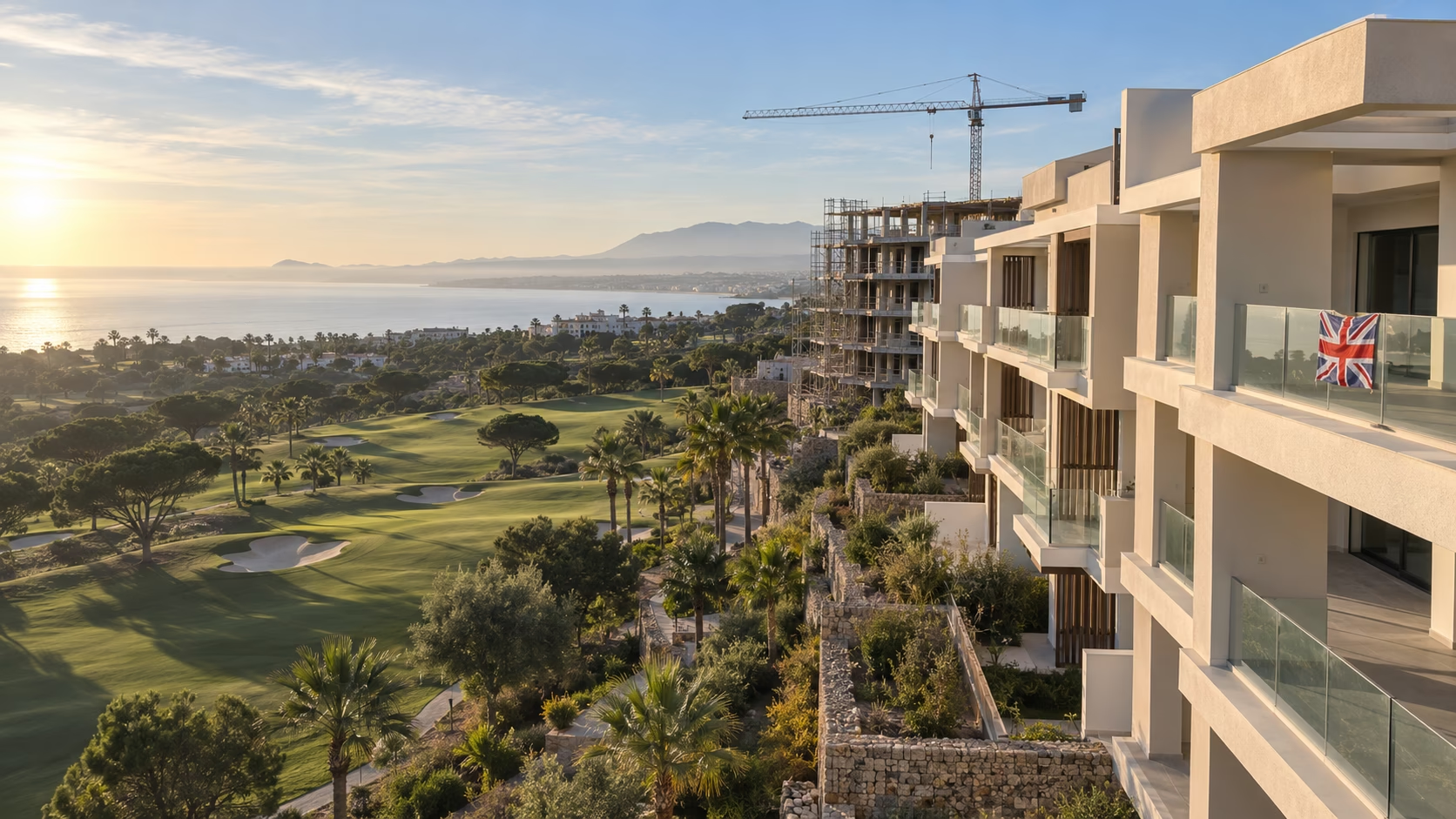
That profile explains the price floor. Resort-serviced, golf-front, three-bedroom stock at La Cala de Mijas is being released from €400,000 plus VAT for apartments and €650,000 plus VAT for townhouses. Nobody in this buyer group is competing for compact one-bedroom coastal apartments. A current example of that product type on the open market: Royal Palms in La Cala de Mijas.
Key insight: the British are not bidding up the whole Costa del Sol. They are concentrated in one narrow band — serviced golf-resort new-builds above €400,000 — and that is precisely the band where new stock sells out on reservation, before completion.
What this means for the private buyer
1. Your competition depends on your budget, not your coast
The sourced thresholds here are the developer's own: €400,000 plus VAT to enter the golf-resort apartments, €650,000 plus VAT for the townhouses, and €560,000 as the average actually paid. Below that entry point you are shopping in a broad market — resale and standard new-build, bid on by a wide mix of nationalities and by Spanish buyers; new-build in Mijas itself still exists just under that line, from €395,000. At and above it, in serviced golf developments, the competing buyer is the one described above: capitalised, retirement-driven, and quick to decide. The practical consequence is that units in that band go at reservation stage, off plan, before completion — so the choice is made from a floor plan, not from a viewing.
2. "Flexible room" is now a pricing feature, not a nice-to-have
When the dominant buyer group in a segment specifically asks for a convertible study or guest room, units that have one resell into that same demand later. A three-bedroom that functions as two-plus-office holds its buyer pool better than a same-size three-bedroom laid out rigidly. This is worth checking on the floor plan before you reserve, not after.
3. A 7% national share does not mean a weak British market
Britons still lead the table of foreign buyers in Spain — but barely. In the second quarter of 2026 the Colegio de Registradores put British buyers at 6.99% of all foreign purchases, the Dutch at 6.94% and Germans at 6.11%. The British lead is now five hundredths of a percentage point. That is not British demand falling; it is the foreign-buyer pool around it widening. What has changed is where British demand sits — it has concentrated, and the Costa del Sol is where it concentrates.
Outlook
Nothing in these figures points to a turn — they extend the pattern running through the wider Spanish property market in 2026. In the second quarter of 2026 foreign buyers took 15.98% of all home purchases in Spain — the highest share on record — and in Málaga province they took 37.01%, some 3,474 purchases, a rise of 20.79% on the same quarter a year earlier. Málaga is not even the peak: neighbouring Alicante ran at 46.43%. Against that, new completions are not arriving fast enough to shift the balance, and Spain's construction labour shortage, flagged the same week, leaves 80% of building vacancies classed as hard to fill. Where supply is constrained and one buyer group concentrates in one product band, that band prices ahead of the average. It is what the €560,000 figure is describing.
For a buyer, the takeaway is simple: decide which side of €400,000 you are on before you start viewing, because the two markets behave completely differently.