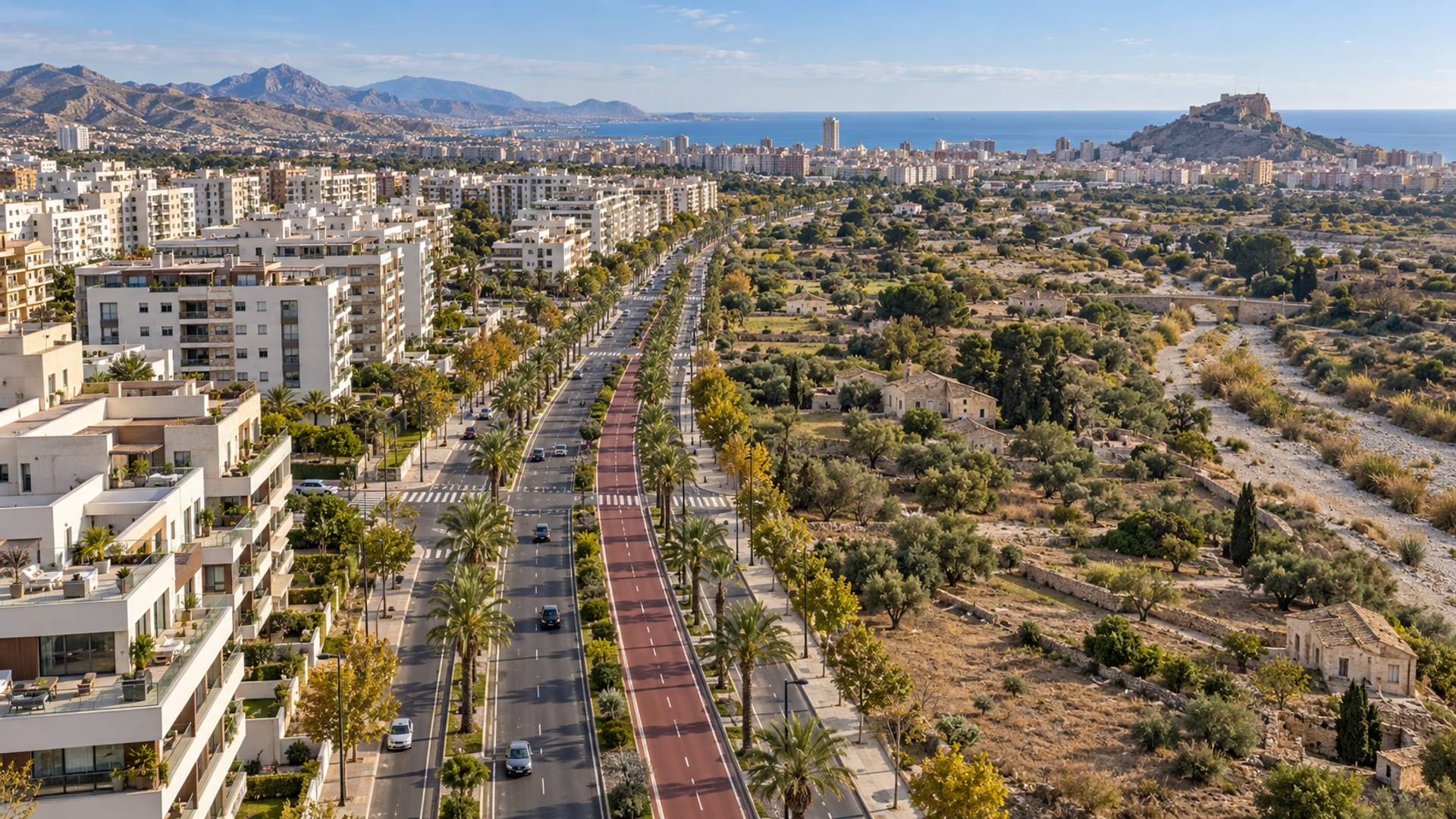
Alicante's next large residential district has a name and a first legal step. On 20 October 2026 the city's governing board agreed to start processing amendment no. 54 to the General Urban Plan, which would turn the El Pino y Ruaya estates on the northern edge of the city into a district of about 2,500 homes, a park of 340,000 square metres and 82,000 square metres of shops, offices and services. The site covers 879,000 square metres along Avenida de Dénia, the main road into Alicante from the north, where the city meets Sant Joan d'Alacant and Mutxamel.
The agreement is the beginning of a procedure, not a building permit. The plan now goes to the Valencian regional government for strategic environmental assessment before it can be approved. No construction date exists, and the councillor for urban planning, Antonio Peral, has said the district will have no immediate effect on current prices. Even so, the decision tells a buyer where Alicante intends to grow in the 2030s, and it comes with a route that avoids waiting for the city's new General Structural Plan.
Where it is: north of the city centre, on the inland side of Avenida de Dénia, between the Hogar Provincial on the CV-818 and the Santa Faz monastery. The urbanisations of La Coix in Sant Joan lie to the north, Les Paulines and Entredós in Mutxamel to the east, La Almajada and Puerta Cerrada on the Alicante side. The beach at Playa de San Juan and the university hospital in Sant Joan are a few minutes' drive along the same avenue.
The project in figures
| Item | Figure |
|---|---|
| Total area of the sector | 879,000 m² |
| Residential zone, medium-density blocks facing Avenida de Dénia | 457,000 m² |
| Homes | About 2,500, of which 40% with protected status |
| Lomas del Pino park | 340,000 m² |
| Commercial and office strip | 82,000 m² |
| Landowners promoting the plan | Lomas del Pino S.L., Sacyr Gestión de Activos S.L., Valirio Investments S.L. |
| Procedure | Amendment no. 54 to the 1987 General Plan; environmental assessment by the Generalitat Valenciana |
The design follows what the council calls an eco-district model: a main internal avenue linking Avenida de Dénia with the CV-818 and CV-821 roads, where the shops and offices would concentrate; residential streets with calmed traffic and priority for walking and cycling; and a park that joins the Juncaret-Lloixa river corridor and the historic market gardens around Santa Faz. The old farmhouses of El Pino and Ruaya, the Lloixa path and the Romèlia arch are to be kept inside the plan. Avenida de Dénia itself is to be redesigned as a boulevard.
Why now: a court ruling from 1992
The land has been classified as developable since a 1992 ruling of the Valencian High Court, but the city's planning in force never incorporated it. Alicante is now drafting a new General Structural Plan, the 45,000-home plan we described in April, and El Pino y Ruaya is already drawn into it. Rather than wait for that plan's final approval, which is still some way off, the council is processing the sector as a separate amendment to the current plan. The council's own wording is that this lets the 1992 ruling take effect sooner while keeping the design in line with the new plan's model for the city.
Key point for timing: a planning amendment of this size in the Valencia region passes through environmental screening, public consultation, provisional approval by the city and final approval by the region, and only then through the detailed urbanisation project and land reparcelling that precede the first building licence. Each stage is measured in months, and the whole sequence in years. A buyer should read "2,500 homes" as a direction for the next decade, not as supply arriving in 2027 or 2028.
The northern growth corridor
El Pino y Ruaya is one of several sectors planned along the same corridor between the city and the Playa de San Juan. Together they describe where most of Alicante's new housing is expected to come from.
| Sector | Planned homes | Status |
|---|---|---|
| El Pino y Ruaya (Avenida de Dénia) | About 2,500 | Procedure opened 20 October 2026 |
| Vistahermosa-Juncaret (PAU 3) | About 3,500 | Planned, in the new General Plan |
| Vista Alegre | About 2,000 | Planned |
| Alameda | About 1,300 | Planned |
This corridor is also where the council has been working on the speed of its own paperwork. On 19 October the planning department met the Alicante architects' association to present a set of measures to shorten licence processing: two technical support contracts already awarded and more staff in the planning discipline unit. No target processing time has been published yet.
What this means for a buyer looking at north Alicante
1. Prices today are set by what exists, not by what is planned
Asking prices in Alicante city averaged €2,721 per square metre in August 2026, according to listing data cited by the local press, and the new-build sectors nearest to this site, from Vistahermosa and PAU 5 to the townhouse developments in Mutxamel and Sant Joan, sell on their own merits: distance to the beach, schools, the tram and the hospital. A plan that will not deliver a home before the end of the decade does not change the arithmetic of a purchase in 2026 or 2027.
2. The 40% protected share is a signal for the other 60%
Protected homes in the Valencia region are sold at capped prices to buyers who meet income and residence conditions, which excludes most foreign purchasers. The 1,500 open-market homes are what will eventually be relevant to a buyer from abroad, and they will come to market in phases, after the urbanisation works are built and paid for.
3. The park and the boulevard are the long-term value
For the urbanisations already standing around the site, in Sant Joan, Mutxamel and the Alicante side of Avenida de Dénia, the useful parts of the plan are the 340,000 square metre park, the commercial strip and the redesign of the avenue. Those are the elements that improve daily life for existing residents, and they explain why the council has framed the project as an eco-district rather than as a housing estate.
4. Choose the district by the existing map
If north Alicante is on your list, the decision today is between the city's beach district at Playa de San Juan, the villa and townhouse areas of Sant Joan and Mutxamel, and the newer apartment sectors inland from the avenue. Our area page for Alicante and our guide to buying new-build property in Spain cover the practical side, from payment schedules to bank guarantees.
Outlook: what to watch
The next visible step is the regional environmental assessment, followed by a public consultation period in which the plan's documents become public. That is when the detail that matters to a buyer appears: building heights, the phasing of the works and the exact location of the open-market homes within the sector. We will update this article when the plan reaches public consultation and again when the council gives it provisional approval.
If you are comparing options in Alicante, Sant Joan and Mutxamel now, ask for a personal selection and we will send what matches your budget from the homes that exist today.