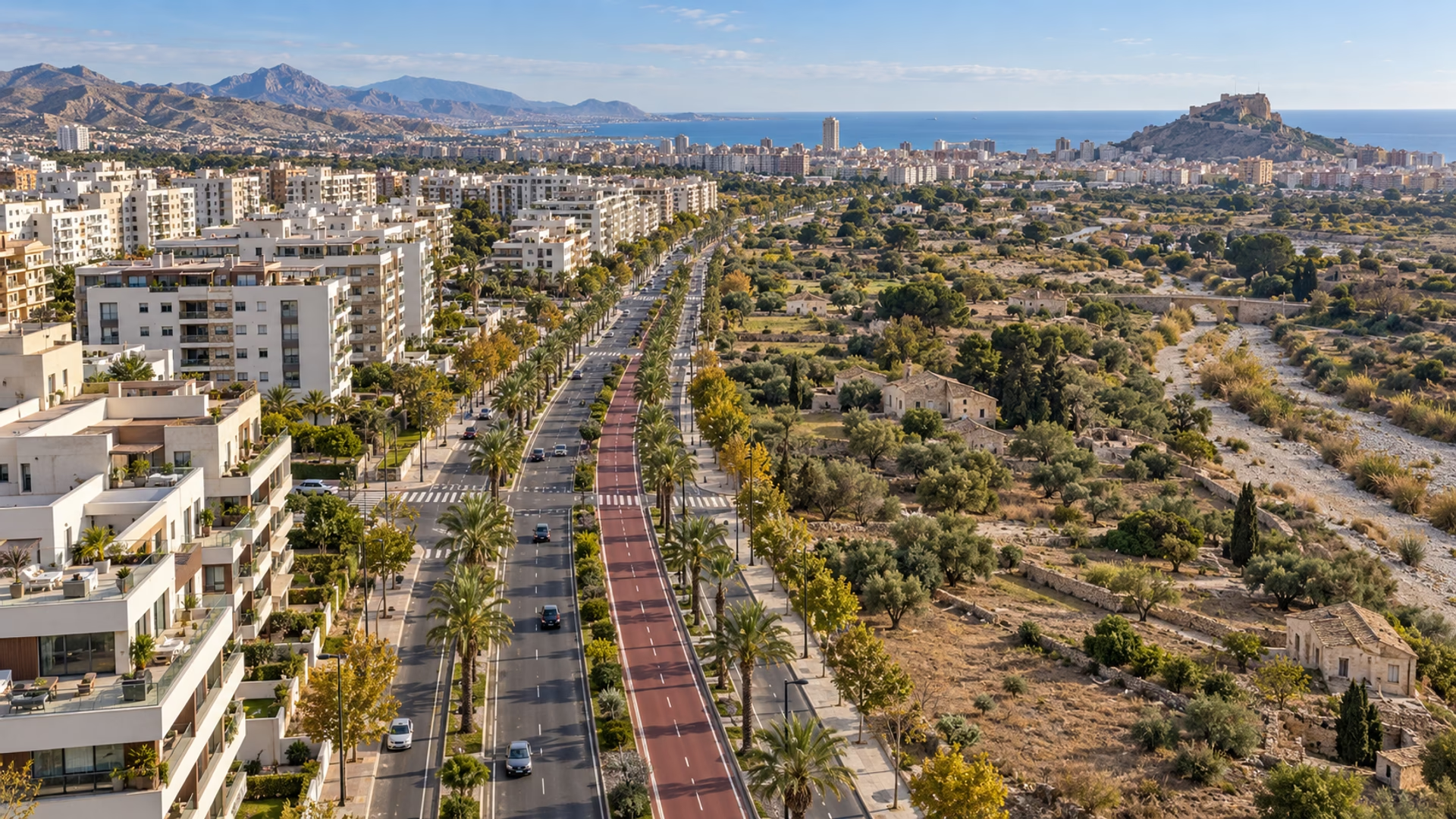
Eight weeks of summer lets in Alicante now bring in around €9,100 — 62% of what a full year of long-term renting earns, according to a pisos.com analysis published on 20 August 2026. It is a striking number, and before anyone builds a purchase around it, it needs one correction: that figure is gross. What actually reaches the owner's account depends on who manages the flat, which services it offers — and, more than anything, on the owner's tax residency.
The numbers behind the headline
The pisos.com study looks at asking prices for holiday lets on the Alicante coast this summer. A beach-area apartment rents for over €4,500 a month in July and August, against roughly €1,225 in an ordinary month — so two summer months produce €9,100, while a year of conventional renting brings €14,707. By Playa de San Juan, a single summer week is listed above €1,780, 8% more than last year. Long-term rents are climbing in parallel: idealista puts the city of Alicante above 13.8 €/m², up 8.6% year on year.
The study works from advertised prices and assumes the weeks are actually booked. Platform commissions, cleaning, management, taxes — none of it is deducted. As pisos.com frames it, the summer "only needs to cover the IBI, the community fees, utilities and a reasonable part of the mortgage payment."
What a short let actually keeps
Run the same €9,100 through a real operation and it shrinks quickly. Booking platforms take roughly 15–18% of each reservation. Weekly changeovers mean cleaning and laundry every few days through the season. An owner who is not on the coast in August hands the keys to a management company — typically 20–25% of revenue on the Costa Blanca. Add the tourist-licence costs and the utilities that guests consume at holiday rates, and it is normal for 40–45% of the gross to be gone before tax. The €9,100 is now closer to €5,200.
The tax line depends on your passport
Then comes the part most headlines skip. Non-resident landlords pay Spain's IRNR on rental income, and the rules split sharply by residency. An owner resident in the EU or EEA pays 19% on the net — after deducting platform fees, management, repairs, insurance, IBI and a 3% annual depreciation of the building value. An owner from outside the EU — a British landlord, for example — pays 24% on the gross, with no deductions at all under the criterion the tax office applied until recently. On €9,100 of summer income that is €2,184 of tax, whether or not the season left any profit behind. A National Court ruling of 28 July 2025 changed that ground: non-EU owners can now claim the same deductions as EU residents. The tax office has yet to fold the new criterion into its official guidance, so claimed deductions can still be challenged — prudent planning keeps the 24%-on-gross scenario in the spreadsheet.
Long-term rental income is taxed at the same IRNR rates — but the cost base underneath it is a fraction of a holiday operation's: no platform commissions, no weekly changeovers, no management percentage, and the tenant pays the utilities. Residency decides the tax here too, and even more sharply: a Spanish tax resident declaring long-term residential rent in the IRPF applies a 50% reduction to the net income (more in designated stressed areas) — a discount that neither EU nor non-EU non-residents get. For a non-EU owner taxed on gross either way, the arithmetic still often lands on the side of the quieter option.
One honest caveat before choosing that option: a long-term contract locks the flat, not just the income. Under Spain's tenancy law the tenant has the right to stay five years (seven if the landlord is a company), plus a further three-year rollover if neither side gives notice — a private owner can reclaim the flat for their own use after the first year only if that clause was written into the contract. So if the plan is to spend summers in the apartment yourself, long-term letting is simply not on the menu: the real comparison is a short-let operation versus an apartment that sits empty — and that changes the maths again. Our guide to renting out property in Spain works through both models in detail.
Three costs that arrive with the tourist licence
First, VAT. A holiday let that offers hotel-type services — reception, periodic cleaning during the stay, linen changes — is treated as hotel accommodation and must charge 10% IVA, with the bookkeeping that follows. And the exemption for service-free lets has an expiry date: from 1 July 2028, under the EU's new VAT framework, stays under 30 nights will carry IVA regardless of services.
Second, the community. Since the 2025 reform of Spain's horizontal property law, a community of owners can restrict or veto new tourist lets with a 3/5 majority — and can approve a surcharge of up to 20% on the community fees of flats used for tourist rental. On coastal urbanisations with pools and gardens, that is no longer a theoretical clause; communities are using it.
Third, the licence itself. In the Valencian Community a holiday let needs a VUT registration, renewals now run on five-year cycles, and a community's veto right applies before the licence does. Holiday demand is real — the Alicante coast ran at 92.2% occupancy this August — but the right to serve it is not automatic.
Where the maths still works
None of this makes short lets a bad business. It makes them a business — one that rewards buildings designed for it. In residences built around rental operation, the reception, cleaning and linen service already exist, the licence structure is part of the project, and the 10% IVA regime is simply how the operation runs — the owner is not improvising a hotel inside a residential community that never agreed to one. One example from our own catalogue: Pure Sea Residence on Playa del Torres, Villajoyosa — a beachfront building with aparthotel services where an apartment can earn from day one, inside the rules.
For a buyer, the order of decisions matters more than the headline yield: first your tax residency and what it does to the net, then the operating model — self-managed, agency, or aparthotel — and only then the flat. Renting in Alicante now absorbs 38% of a household's income; the demand side of this market is not the problem. The spreadsheet is where summer numbers are won or lost.