Anyone can buy a holiday home in Spain: there are no restrictions on foreign buyers, whatever your passport. What the purchase does not give you is the right to live there: owning a home in Spain does not extend how long you may stay, and it does not lead to residency on its own. Three questions decide whether a second home in Spain works for you: how many weeks a year you will actually spend there, whether you plan to rent it out while you are away, and what it costs to keep each year when nobody is in it. This guide takes them in that order, then looks at the type of property and the places that suit a home you visit rather than live in.
Can a foreigner buy a holiday home in Spain?
Yes. Spain does not limit property purchases by nationality or residence. EU citizens, British, American, Norwegian or any other buyers go through the same process: obtain an NIE (the foreigner's tax identification number), open a Spanish bank account, sign the deed before a notary and register the property. The proposed 100% tax on non-EU buyers, much discussed since January 2025, was never passed, and the bill lapsed when the Spanish parliament was dissolved in October 2026.
The purchase of a holiday home follows exactly the same steps as any other purchase, set out in our step-by-step guide to buying property in Spain. What changes is everything that comes after the keys: how often you can be there, who looks after the home, and how it is taxed while you are not living in it.
How long you can stay in your holiday home
This is the question that matters most to buyers from outside the EU, and the answer surprises many of them: the rules depend on your passport, not on the property.
Citizens of the EU, EEA and Switzerland
There is no limit on how long you may stay. If you start living in Spain for more than three months, you are expected to register as a resident, and if you spend more than 183 days in a calendar year in Spain, you normally become a Spanish tax resident. As long as the home remains a place you visit, you stay a non-resident for tax purposes and pay the non-resident taxes described below.
Everyone else, including British and American owners
Without a visa or residence permit, you can spend up to 90 days in any 180-day period in the Schengen area as a whole, not per country. Days spent in France or Italy count towards the same 90. Owning a home in Spain does not change this; our guide for Americans buying property in Spain covers the US side in detail. Since 10 April 2026 the EU's Entry/Exit System (EES) records every entry and exit electronically at the external borders, so the count is now automatic rather than based on passport stamps. A separate travel authorisation for visa-free visitors, ETIAS, is scheduled to follow; check its status before you travel.
In practice, 90 days in 180 allows a pattern such as six weeks in spring and six weeks in autumn, or three months in winter followed by three months away. Owners who want to spend longer periods in their Spanish home need a residence visa; the routes for each passport are set out in our guide to moving to Spain. For buyers who do not work in Spain, the usual route is the non-lucrative visa, which requires proof of sufficient passive income and private health insurance. Since the Golden Visa was abolished in April 2025, buying a property no longer leads to residency by itself.
What a holiday home costs to run each year
The running costs of a second home in Spain are lower than in most of Northern Europe, but they arrive whether or not you use the home. A typical year consists of the following items.
| Cost | Who sets it | What decides the amount |
|---|---|---|
| IBI (local property tax) | Town hall | 0.4–1.1% of the cadastral value, a tax value usually well below the market price |
| Non-resident income tax (Modelo 210) | Spanish Tax Agency | Payable even if the home is never rented; see the example below |
| Community fees (gastos de comunidad) | The community of owners | Pool, gardens, lifts, security and the size of your unit |
| Rubbish collection (basura) | Town hall or regional body | A flat annual charge, sometimes billed with the water |
| Home insurance | Your insurer | Size, contents and cover; required by the bank if you have a mortgage |
| Electricity, water, internet | Suppliers | Standing charges continue when the home is empty |
The tax most owners forget: imputed income
Spain assumes that a home you own but do not rent out gives you a notional income, and taxes it. The taxable amount is 1.1% of the cadastral value (2% if the town's cadastral values have not been revised in the last ten years), and the rate is 19% for residents of the EU and EEA and 24% for everyone else. For a home with a cadastral value of €100,000, that is €1,100 of imputed income and €209 a year in tax for an EU resident, or €264 for a non-EU resident. It is declared on Modelo 210 by 31 December of the following year, prorated if you owned the home for only part of the year. The full rules, including what changes in the years you rent the home out, are in our guide to property taxes in Spain for non-residents.
Wealth tax only comes into play above €700,000 of net assets in Spain, so it does not apply to most holiday homes.
If you sell the home later while still a non-resident, the gain is taxed at 19% in Spain, and the buyer withholds 3% of the price and pays it to the Tax Agency as an advance on that tax.
Community fees: ask before you buy
In an apartment complex or an urbanisation with shared facilities, community fees are often the largest running cost after taxes. They are set by each community's annual budget, so there is no national average worth quoting. Before signing, ask the seller for the current fee, a certificate confirming there are no unpaid debts, and the minutes of the last owners' meetings. The minutes show whether repairs, a new lift or a pool refurbishment have already been voted and will be billed to the new owner.
Apartment or villa: what works when you are away
A home you use for a few weeks at a time needs to look after itself for the rest of the year, and the type of property decides how much of that is done for you.
- Apartment or townhouse in a complex. The community pays for the pool, the gardens and often a caretaker or security; you lock the door and leave. This is why apartments and bungalows in complexes make up most holiday-home purchases on the coast.
- Detached villa. More privacy and space, no shared rules, but the garden, the pool and the house itself depend on you. Owners usually hire a pool service, a gardener and a key-holder who checks the property regularly, opens the windows and deals with any problem after a storm.
Spanish property terms do not always mean what buyers expect: a "bungalow" in Spain is usually a ground-floor or upper-floor unit in a low-rise complex, not a detached house. Our guide to property types in Spain explains the differences.
Renting it out when you are not there
Many owners plan to cover the running costs by letting the home in the weeks they do not use it. That is possible, but three separate permissions and obligations apply, and the first one is easy to miss.
- The community of owners. Since 3 April 2025, a community of owners can require its express approval for any new holiday let in the building, by a three-fifths majority, and can also restrict or prohibit it. If renting out is part of your plan, ask before buying whether the community has already voted on holiday lets and read its statutes.
- The regional tourist licence. Tourist lets are regulated by each region (Valencian Community, Andalusia, Murcia, the Balearic Islands), and some towns limit or stop new licences in certain districts. The licence belongs to the property, so check whether the home already has one and whether the town still grants new ones.
- Guest registration and tax. Every guest must be registered with the authorities. Rental income is declared on Modelo 210: residents of the EU and EEA pay 19% on the income after deductible expenses, everyone else 24% on the gross income.
Lets of one to eleven months for a specific purpose, such as a work contract or a university term, follow different rules and do not need a tourist licence. The rules for each region and each type of letting are set out in our guide to renting out property in Spain.
Is a holiday home in Spain worth it for you?
There is no general answer, but the calculation is simple enough to do for your own case. It comes down to three figures.
- The weeks you will really spend there. Count the holidays you take now, not the ones you hope to take. Owners who visit several times a year, or stay for a month or more at a time, get far more from a home than those who come for one summer fortnight.
- What owning costs each year. The running costs above, plus the return the same money would earn if it stayed invested. Compare the total with what you spend today on holiday accommodation for the same number of weeks.
- What letting can add. Rental income can cover part of the costs (eight summer weeks in Alicante gross around €9,100, before management and tax), but only if the community and the town allow holiday lets, and only in the weeks you do not use the home yourself. Peak weeks are usually the ones owners want for themselves.
The rest is not a number: a home that is ready when you arrive, with your own things in it, in a place you know. For many owners that is the reason to buy, and the figures only need to show that the cost is one they are comfortable with.
Where holiday-home buyers look
For a home you fly to several times a year, the distance to the airport matters as much as the beach. So does choosing a town where restaurants, shops and services stay open outside the summer, so that a visit in November is as easy as one in July. These five places combine both:
| Town | Nearest airport | What it offers a holiday-home owner |
|---|---|---|
| Guardamar del Segura | Alicante-Elche, about 35 km | The closest town on the southern Costa Blanca to the airport, with long sandy beaches backed by a pine forest |
| Torrevieja | Alicante-Elche, about 45 km | A town of almost 100,000 registered residents that stays fully open all year, with a large choice of apartments in complexes |
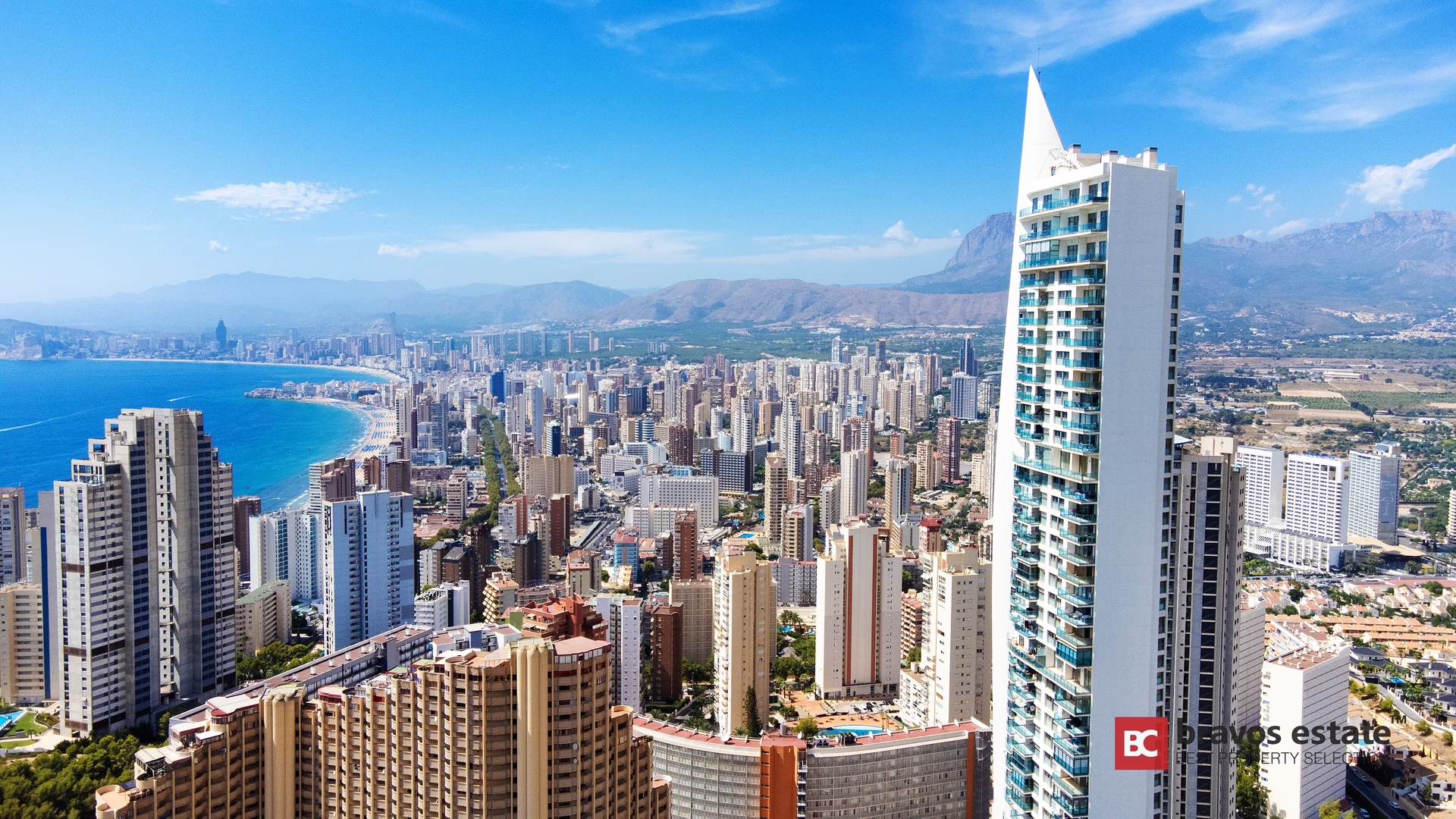
| Benidorm and Finestrat | Alicante-Elche, about 60 km | A town that works all year, with high-rise apartments facing two Blue Flag beaches |
| Fuengirola | Málaga, about 25 km | The end station of the C-1 train, which runs straight to Málaga airport |
| Los Alcázares | Región de Murcia, about 35 km | On the Mar Menor, a shallow lagoon with calm, warm water |
These are not the only good choices. Our guide on where to buy property in Spain compares the coasts town by town, with prices per square metre, climate and the holiday-let rules in each region.
Looking after the home from abroad
A holiday home that is visibly used is both better maintained and better protected. Owners who live elsewhere usually arrange four things:
- A key-holder or property manager who checks the home after storms and before your arrival, receives deliveries and lets in technicians.
- Utilities in your name with real consumption. Besides keeping the home ready for use, this is the strongest proof that it is a lived-in home. Under Spanish law, a furnished second home that is genuinely used is protected as a dwelling (morada), so anyone who enters it unlawfully can be removed quickly. Our guide on okupas in Spain explains how this works and how small the risk is for homes in managed complexes.
- Insurance written for a second home. Check how the policy treats long periods when nobody is in the home: some policies only pay for water damage or break-ins if the home is checked regularly or the water is shut off at the mains while you are away.
- Direct debits from a Spanish bank account for IBI, community fees, rubbish collection and utilities, so that no bill goes unpaid while you are away. Many owners also appoint a tax representative or adviser to file Modelo 210 each year.
Buying a holiday home with a mortgage
Spanish banks lend to non-residents for second homes, usually up to 60–70% of the purchase price or the bank's valuation, whichever is lower. In practice, plan to have 40–50% of the price available in cash: the deposit plus purchase taxes and fees, which add roughly another 10–15% depending on the region and on whether the home is new or resale. Rates, terms and the documents banks ask for are covered in our guide to mortgages in Spain for foreigners.